Most Americans Uncomfortable With Transgender Athletes Playing on Teams Aligned With Their Gender Identity, Pew Survey Finds
Most Americans Uncomfortable With Transgender Athletes Playing on Teams Aligned With Their Gender Identity, Pew Survey Finds
A new survey from the Pew Research Center reveals that a clear majority of Americans express discomfort with transgender athletes participating on sports teams that align with their gender identity rather than their sex assigned at birth. The findings land as the national conversation around eligibility rules in women’s and girls’ sports intensifies, fueled by high-profile legal battles and a recent U.S. Supreme Court ruling.
The survey, conducted against the backdrop of a summer that put transgender athletes’ participation in the spotlight, underscores how public opinion is becoming a central force in the political and cultural tug-of-war over fairness, inclusion, and safety in competitive athletics.
Public Discomfort Cuts Across Demographics
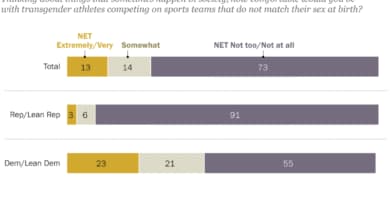
While Pew’s data point to broad unease, the discomfort is not monolithic. The report shows that views diverge sharply along political, ideological, and religious lines. People who identify as Republican or conservative are significantly more likely to oppose transgender athletes competing on teams that do not match their birth sex, while Democrats and liberals are more divided on the issue, with a notable minority expressing support for inclusion policies.
Age also plays a role. Younger adults tend to be more comfortable with transgender athletes competing according to their gender identity, whereas older generations express greater reservations. Religious affiliation, particularly among white evangelical Protestants, is also associated with stronger opposition.
These demographic splits mirror the broader American polarization on LGBTQ+ rights and reflect the enduring tension between calls for equal opportunity and arguments about competitive fairness.
A Legal and Political Flashpoint
The public opinion landscape is being shaped by a cascade of legal and policy developments. The U.S. Supreme Court ruled in June on a matter related to transgender rights, though the Court did not directly mandate a uniform standard for sports participation. The decision nevertheless injected new legal urgency into an already heated debate, prompting state lawmakers and sports governing bodies to revisit their own eligibility rules.
At the federal level, lawmakers have proposed legislation that would define sex-based eligibility in school sports strictly by biological sex. Meanwhile, more than 20 states have passed laws banning transgender women and girls from competing in female sports categories. These measures have drawn both fierce support from advocates who argue they protect the integrity of women’s sports and sharp criticism from civil rights groups who say they discriminate against transgender youth.
Governing Bodies Grapple With Inconsistent Policies
The confusion extends to sports organizations themselves. The NCAA, which sets eligibility rules for college athletics, has a policy that allows transgender athletes to compete under certain conditions but has faced pressure from both sides. Some athletes and parents have sued the organization, contending that its rules create an unfair playing field or violate Title IX protections.
International federations have taken varied approaches. World Athletics and World Aquatics have imposed stricter testosterone-based limits, effectively barring many transgender women from elite female competition, while other sports bodies have adopted more inclusive frameworks. These inconsistencies amplify the public’s uncertainty and fuel the debate that Pew’s survey captures.
Where the Public Lands
The Pew survey highlights that most Americans, regardless of their stance on broader transgender rights, draw a line when it comes to competitive sports. The discomfort is not purely about ideology; it is often rooted in perceptions of physical advantage and the perceived fairness of competition. Even among groups generally supportive of transgender inclusion, the questions of locker room access, scholarship opportunities, and record-setting possibilities create friction.
“The data show that the public is grappling with genuine, nuanced questions about fairness and opportunity,” said a Pew researcher in a statement accompanying the release. “It’s not a simple yes-or-no issue for many people.”
Looking Ahead
As the 2028 Los Angeles Olympics approach and the next generation of athletes prepares for competition, the intersection of public opinion, law, and sports policy will only grow more complex. The Pew survey indicates that the American public is deeply engaged with the question of who gets to compete—and that the conversation is far from settled.
For now, the numbers make one thing clear: most Americans are not comfortable with transgender athletes participating on sports teams that don’t match their birth sex. Whether that sentiment translates into lasting policy change or further legal challenges remains to be seen, but the debate is certain to stay at the center of the national sports landscape.