
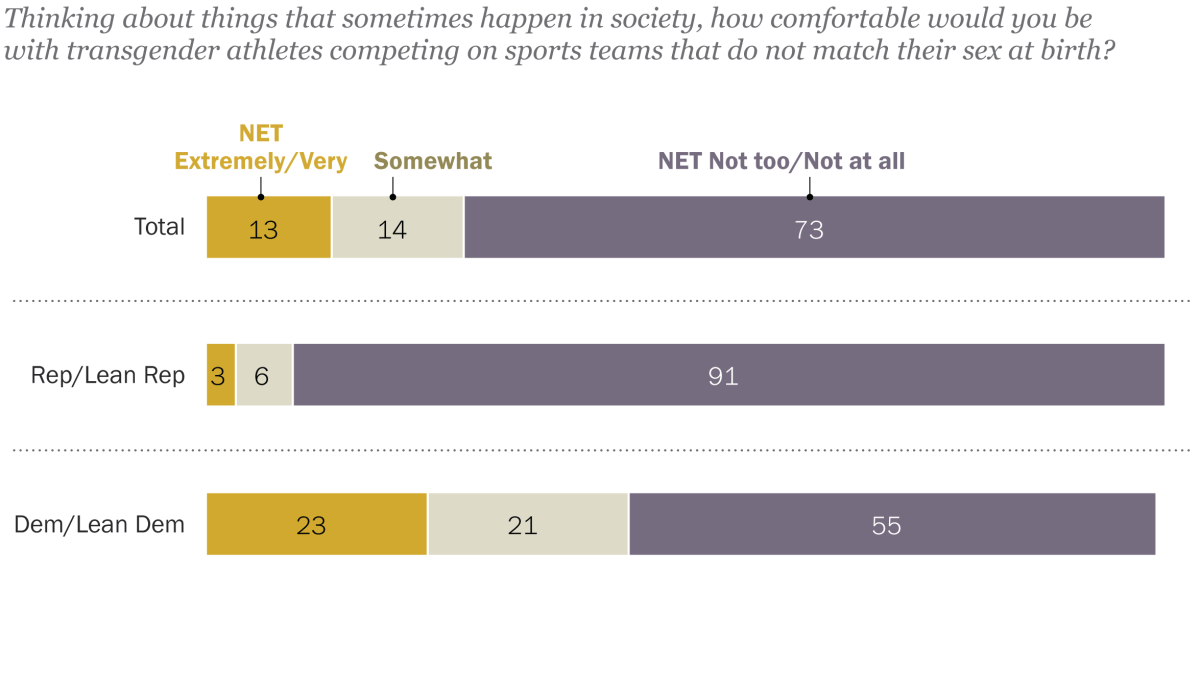
Majority of Americans Uncomfortable with Transgender Athletes in Sports Aligned with Gender Identity, Pew Poll Shows
Survey Highlights Widespread Discomfort
A new national survey from the Pew Research Center reveals that a majority of Americans express discomfort with transgender athletes participating on sports teams that align with their gender identity rather than the sex they were assigned at birth. The findings arrive amid a summer where trans inclusion in athletics — particularly in women’s and girls’ sports — has attracted heightened public and legal attention.
Women’s Sports at the Heart of the Debate
The survey underscores that the unease is most pronounced when it comes to female categories. The participation of transgender women and girls in women’s sports has become a central flashpoint, fueling legislative battles, school board disputes, and policy changes at every level of competition from youth leagues to the Olympic stage.
The Pew poll’s topline results indicate that discomfort spans multiple demographic groups, though the data also suggest meaningful variation by age, political affiliation, and perhaps by the level of sport — from recreational youth leagues to elite collegiate athletics. A deeper analysis of the survey’s crosstabs may illuminate these nuances.
A Summer of Legal and Policy Shifts
The timing of the survey is significant. This summer, the U.S. Supreme Court issued a ruling that touched on the broader legal framework surrounding transgender rights, including implications for education and athletics under Title IX, the federal law prohibiting sex-based discrimination. While the Court’s opinion did not directly resolve the sports question, it added momentum to an already charged environment.
At the federal level, the Department of Education’s Office for Civil Rights continues to navigate how Title IX applies to gender identity. Meanwhile, state lawmakers have enacted a patchwork of legislation, with more than 20 states restricting transgender participation in school sports, while others have passed protective measures affirming inclusion. These statutes often conflict, leaving athletes, coaches, and administrators in a legal gray area.
Governing Bodies React
Major athletic organizations have also grappled with the issue. The NCAA adopted a sport-by-sport approach in 2023, deferring to each sport’s national governing body for eligibility criteria. This shift created a landscape where rules vary dramatically depending on the sport, leaving transgender athletes facing a confusing and often exclusionary patchwork.
Advocacy groups on both sides of the debate have seized on the survey. Those pushing for restrictions say the public’s discomfort validates their stance that fairness in women’s sports is at risk. LGBTQ+ advocacy organizations, on the other hand, argue that discomfort often stems from misunderstanding and that inclusive policies are essential for the well-being of transgender youth.
What the Public Thinks
Pew’s survey adds to a growing body of polling that consistently shows a divide in American opinion on this topic. The specific phrase “uncomfortable” captures a sentiment that may be less absolute than outright opposition yet signals a broad unease that policymakers must consider.
Although the survey offers a snapshot of current attitudes, its release during a period of intense scrutiny ensures the findings will fuel ongoing debates in Congress, statehouses, and school board meetings. As legal and cultural battles unfold, the data from Pew provides a crucial benchmark of where the American public stands on one of the most contentious issues in modern sports.