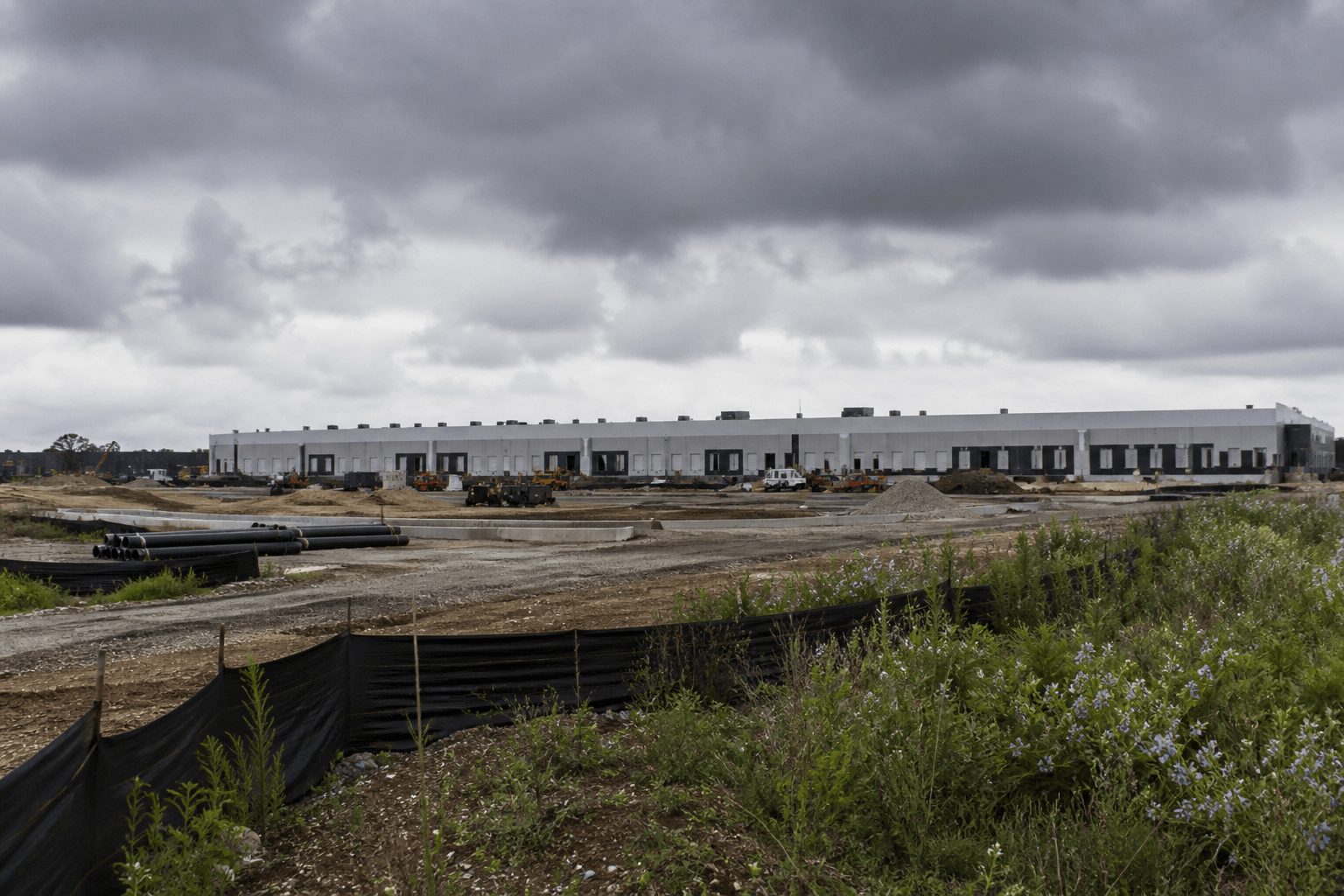
CoreWeave’s $6 Billion Lancaster Data Center Sparks AI Land Rush as Powered Plots Top $8M Per Acre
CoreWeave Bets Big on Lancaster in Record AI Infrastructure Land Grab
CoreWeave’s proposed $6 billion data center campus in Lancaster has become the poster child for an accelerating U.S. land rush, where voracious demand for artificial intelligence compute is reshaping real estate markets and pushing the price of shovel-ready power sites past $8 million per acre.
The massive project anchors a historic surge in data center land investment. According to market data, investors poured an estimated $6 billion into data center land acquisitions across the United States in the first half of 2026 alone, a pace that far outstrips previous cycles and signals panic-buying for the finite resource of utility-interconnected parcels. The Lancaster site – with its combination of available land, robust power transmission infrastructure and favorable local permitting – embodies exactly what hyperscalers and AI cloud providers are fighting over.
Why Lancaster? The Calculus of the AI Land Rush
Selecting a site for a $6 billion compute campus is not just about square footage. CoreWeave’s decision to anchor in Lancaster reflects the same checklist now driving the broader land grab: power availability is the overriding concern. The U.S. Energy Information Administration has repeatedly flagged that electricity demand from data centers could double by 2030, making access to high-voltage transmission corridors the single most critical factor in site selection.
Lancaster sits within reach of substantial transmission capacity that can be upgraded faster than in many constrained markets like Northern Virginia, where interconnection queues stretch for years and power costs are climbing. Land costs, while soaring by historical standards, remain below those in the epicenter of the land rush. A powered site here still comes at a premium – likely north of the $8 million-per-acre threshold now considered baseline for serious data center plays – but compared with the $15 million or more some parcels are commanding in primary markets, Lancaster represents a relative value play for a company looking to deploy tens of thousands of GPUs at speed.
Local government incentives and a planning regime that has proven willing to fast-track data center development also factored heavily. Municipalities facing flat or declining industrial tax bases see hyperscale projects as a lifeline for fiscal stability, even as residents and environmental groups raise questions about grid strain and water consumption.
CoreWeave’s Compute Ambition and the AI Capacity Crunch
The Lancaster campus is not just a real estate play – it’s a firing line in CoreWeave’s strategic push to become the go-to infrastructure provider for the next wave of AI training and inference. The company, which has rapidly scaled its GPU fleet to serve customers running large language models, generative media pipelines and scientific computing workloads, is betting that owned-and-operated campuses will give it cost and availability advantages over pure lease arrangments.
Industry analysts have noted that the Lancaster site, once operational, could house hundreds of megawatts of critical IT load. That capacity is desperately needed: cloud providers and enterprise AI teams are competing for scarce high-density colocation space, and build-out timelines have stretched to 36 months or more in some regions. By controling its own destiny on land and power, CoreWeave aims to shrink that window dramatically.
“The tier-one data center markets are effectively sold out of available power for large-scale deployments until at least 2028. Developers are now racing to secure any site with a credible path to 200MW or more, and Lancaster is one of the few places left where that path still exists at reasonable cost.”
That comment, from an infrastructure investor briefing, encapsulates why $6 billion in land deals were struck in just six months. CBRe’s latest data center market report underscores the trend: competition for powered land is so intense that parcels without a clear power roadmap are being snapped up for speculative rezoning, a stark reversal from the cautious underwriting standards of just three years ago.
Local Dividends and Divides
F or Lancaster, the promise of thousands of construction jobs and hundreds of permanent high-tech positions is being weighed against concrete infrastructure demands. The data center is projected to generated tens of millions of dollars in annual property tax revenue, funds that local officials see as transformative for schools and public safety. Yet the facility’s electricity draw – potentially hundreds of megawatts – will require significant grid upgrades that could spill costs onto ratepayers if not structured carefully.
Water usage is another flashpoint. While CoreWeave has not publicly detailed its cooling design, most large-scale AI data centers rely on evaporative cooling systems that can consume millions of gallons of water per day in hot climates. In regions where water resources are already stressed, that footprint has triggered moratoriums on new data center construction. Lancaster’s water availability is likely to become a key focus of environmental review, and the project’s approval will hinge on demonstrating a sustainable water plan.
Zoning and environmental impact assessments are underway. The scale of the project – potentially spanning hundreds of acres – means that community engagement will be intense, with noise, traffic and esthetic concerns added to the usual energy and water debates. City planners have signaled a willingness to work with the developer, but the timeline for final entitlements remains uncertain.
The $8 Millon-per-Acre New Normal
The Lancaster deal is not an outlier. It is the new baseline for serious AI infrastructure bets. Prices for powered data center sites have topped $8 million per acre in multiple transactions this year, according to market data, and in a handful of trophy locations, bids have exceeded $10 million. That prices out all but the most well-capitalized hyperscalers and the biggest AI cloud providers – precisely the cohort that CoreWeave is look to join.
Investors are pouring capital into the space not just through direct land buys but via joint ventures and infrastructure funds that are competing with traditional data center operators. The $6 billion land spend in H1 2026 reflects both the scale of the AI opportunity and a growing belief that the window to acquire power-ready sites at any price is closing fast.
For CoreWeave, the Lancaster campus is a declaration of intent. The company is signaling that it will not be constrained by the colocation supply chain and is willing to place a multibillion-dollar wager on a secondary market to win the AI capacity war. Whether that wager pays off will depend as much on the local power utility’s upgrade schedule and community water politics as it does on the trajectory of AI demand. But in the current land rush, standing still is no longer an option.
Additional market context: U.S. Energy Information Administration data on data center electricity demand (EIA.gov) and CBRe’s latest scoring of tech future data center opportunities and trends (CBRe report).