UCSB Lands Federal Grant to Build AI-Driven Cloud Lab for Nationwide Research
The University of California, Santa Barbara, has secured a four-year federal grant to establish an artificial intelligence–programmable cloud laboratory, a first-of-its-kind facility that will allow researchers from anywhere in the United States to design and execute experiments remotely through an AI-powered platform. The award, announced this week, marks a significant federal investment in the infrastructure of automated, cloud-based scientific research and positions UCSB as a national hub for next-generation experimentation.
A New Era of Remote Experimentation
Cloud laboratories are virtualized research environments where robotic systems and sensors in a physical lab are controlled entirely through web-based interfaces. Instead of needing to be physically present, scientists can submit experimental protocols, adjust parameters, and retrieve results from their own computers. By integrating artificial intelligence, UCSB’s new facility will go a step further: AI algorithms will be able to learn from each experiment, optimize procedures in real time, and even suggest entirely new hypotheses to test.
“AI-programmable” means that researchers will not just use a remote interface; they will be able to instruct the lab’s software to autonomously explore a parameter space, analyze outcomes, and iteratively refine the experiment without constant human oversight. This dramatically accelerates the pace of discovery and lowers the barrier for scientists at smaller institutions or in underserved regions who lack access to expensive equipment.
Open to the Entire U.S. Research Community
A key feature of the grant is the stipulation that the cloud laboratory will be accessible to any researcher in the country. Unlike many federally funded facilities that are restricted to the host institution’s faculty and students, this lab is designed as a national resource. The open-access model aims to democratize high-end experimentation, allowing a chemist in rural Montana or a materials scientist at a community college to run the same sophisticated tests as a researcher at a major university.
University officials emphasized that the lab’s open access policy will allow scientists across the country to log in, submit experiments, and receive data without traveling to Santa Barbara. The National Science Foundation has long championed shared cyberinfrastructure, but the UCSB initiative represents a major leap toward physically automated, remotely operated laboratories that blend AI with hands-on experimentation. (The specific federal agency providing the grant has not been disclosed publicly.)
Why AI Matters for Lab Science
Traditional scientific research is often bottlenecked by human labor—pipetting, measuring, entering data. Cloud labs already replace these manual tasks with robotic systems. Adding AI turns those robots from simple executors into intelligent partners. The AI can detect anomalies, predict outcomes, and guide the researcher toward the most promising experiments, effectively running hundreds of trials in the time it would take a human to do one.
For UCSB, the project is expected to accelerate work across multiple disciplines. While the university has not yet named the exact departments or lead investigators overseeing the grant, fields such as chemical synthesis, drug discovery, and advanced materials science stand to benefit enormously. Automated cloud labs have already shown promise in rapidly screening catalysts for green energy or optimizing chemical reactions for pharmaceuticals. With AI in the loop, those capabilities expand exponentially.
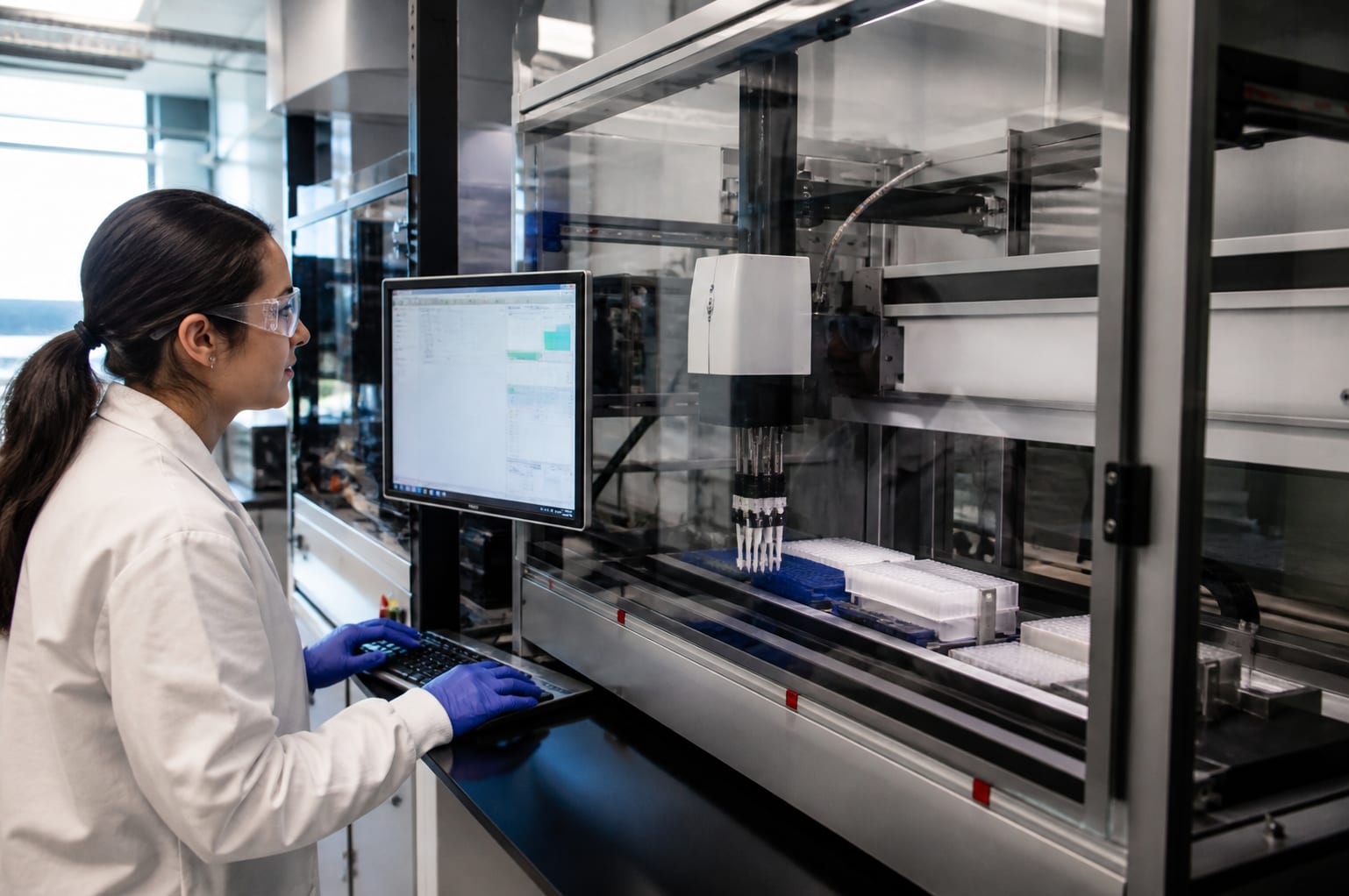
The cloud laboratory will be built on campus and equipped with robotic arms, liquid handlers, and analytical instruments all connected to a central AI control system. Researchers will access it through a secure web portal, submitting experimental workflows that the AI interprets and executes, with results streamed back in real time.
Federal Backing Signals National Priority
The four-year grant reflects a growing federal recognition that the next frontier in scientific competitiveness lies not only in computational infrastructure but in physical automation infused with artificial intelligence. Similar labs have been built at other institutions, but the UCSB project’s emphasis on AI programmability and nationwide open access sets it apart.
As global competition for AI-driven innovation intensifies, the U.S. government is investing in platforms that can serve the entire research ecosystem. The UCSB cloud lab could become a blueprint for future federally funded remote research hubs, linking together a network of AI-equipped facilities that scientists can tap into from anywhere in the world.
Beyond accelerating research, the lab will also serve as a training platform for students and early-career scientists, giving them hands-on experience with AI-driven automation and remote collaboration—skills increasingly vital in the modern scientific workforce.
Planning and construction of the lab are expected to begin within the next few months, with the first remote experiments slated for the project’s second year. For more information, visit UC Santa Barbara’s official newsroom.