Six Months Into Iran War, the Strait of Hormuz Is Now the White House’s Top Concern
Six Months Into Iran War, the Strait of Hormuz Is Now the White House’s Top Concern
When President Donald Trump launched the U.S. military campaign against Iran in late February, he told senior aides and allies that the conflict would be quick and decisive — lasting no more than four to five weeks. Six months later, the war has not only outlasted that initial timeline, but the administration has quietly shifted its core objectives. According to multiple officials and defense analysts, protecting the Strait of Hormuz and securing the surrounding maritime lanes has become the central strategic priority, eclipsing the original, more ambitious aims that drove the decision to go to war.
A War That Outlasted Its Timeline
The initial planning for the Iran campaign was built on the assumption of a short, sharp operation. President Trump’s February remarks, confirmed by officials familiar with the discussions, set the expectation of a conflict measured in weeks, not months. The prolonged nature of the fighting — now stretching into a seventh month — has forced the Pentagon and the White House to recalibrate. The early military objectives, which included neutralizing Iran’s ballistic missile program and degrading the Islamic Revolutionary Guard Corps, remain partially unfulfilled, but the operational focus has drifted toward a more defensive posture: keeping the world’s most critical oil chokepoint open.
The Strait of Hormuz: A Strategic Chokepoint
The Strait of Hormuz, a narrow waterway between Iran and Oman, is the maritime gateway for roughly one-fifth of all global oil consumption. According to the U.S. Energy Information Administration, the strait handled an average of 20 million barrels of petroleum products per day before the war. Any significant disruption there sends immediate shockwaves through energy markets, spiking prices and threatening economic stability far beyond the Gulf region. The International Energy Agency has repeatedly flagged the strait as a “major supply risk,” and the current conflict has turned that risk into a daily operational reality.
Shifting American Priorities
Within the administration, the shift is evident in both resource allocation and public messaging. The U.S. Department of Defense has reportedly surged maritime patrols, mine-clearing operations, and escort missions for commercial vessels transiting the strait. While strike operations against Iranian military infrastructure continue, they are increasingly calibrated to deny Tehran the ability to mine the waterway or launch anti-ship missiles — a departure from earlier, broader offensive goals. “The original plan envisioned a rapid collapse of Iran’s capacity to project force,” one senior defense source told WWL. “Now we’re managing a protracted security environment where the mission is to safeguard global commerce.”
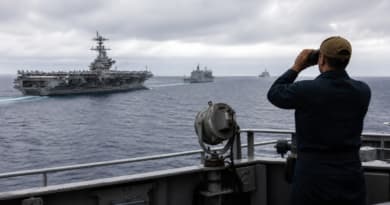
The pivot has significant implications for the U.S. military posture in the region. Naval assets that might have been deployed for deep-strike missions are being held back to protect the carrier groups and amphibious ready groups operating in the Gulf of Oman and the Arabian Sea. The Air Force, too, has redirected some of its ISR (intelligence, surveillance, reconnaissance) flights toward monitoring Iranian coastal defenses and small-boat swarms, which pose a persistent threat to tankers.
Regional and Economic Fallout
The Gulf states, already uneasy about the war’s trajectory, are watching the new focus on the strait with a mixture of relief and alarm. Saudi Arabia, the United Arab Emirates, and Kuwait rely on the unimpeded flow of oil exports, and any miscalculation that closes the strait — even temporarily — would devastate their economies. However, a prolonged U.S. presence engaged in a low-intensity, sea-focused conflict also raises the specter of a wider escalation that could draw in Iran’s proxies in Iraq, Syria, and Yemen.
Energy markets have been volatile but not panicked. The initial price surge after the war began has given way to a risk premium that fluctuates with each reported incident near the strait. Insurers have raised war-risk premiums for hulls transiting the region, and some shipping companies are rerouting cargos around the Cape of Good Hope, adding time and cost. The situation has underscored how a war that was supposed to be short can become a chronic drag on global trade.
The Elusive Endgame
Six months in, the question of an endgame looms larger than ever. The Trump administration has not articulated a clear exit strategy, and the shift to protecting the Strait of Hormuz suggests that a decisive military victory is no longer the expected outcome. Instead, the U.S. appears to be settling into a containment-plus role — ensuring Iran cannot strangle the global economy while diplomatic backchannels, so far unproductive, seek a de-escalation formula.
Critics argue that the reorientation toward the strait is a tacit admission that the war’s original goals were unrealistic. Supporters counter that protecting maritime traffic is a core national-security interest and that the U.S. cannot afford to abandon the region to Iranian coercion. Either way, the protracted conflict is reshaping American strategy in the Middle East, with the Strait of Hormuz now at the center of a war nobody expected would last this long.