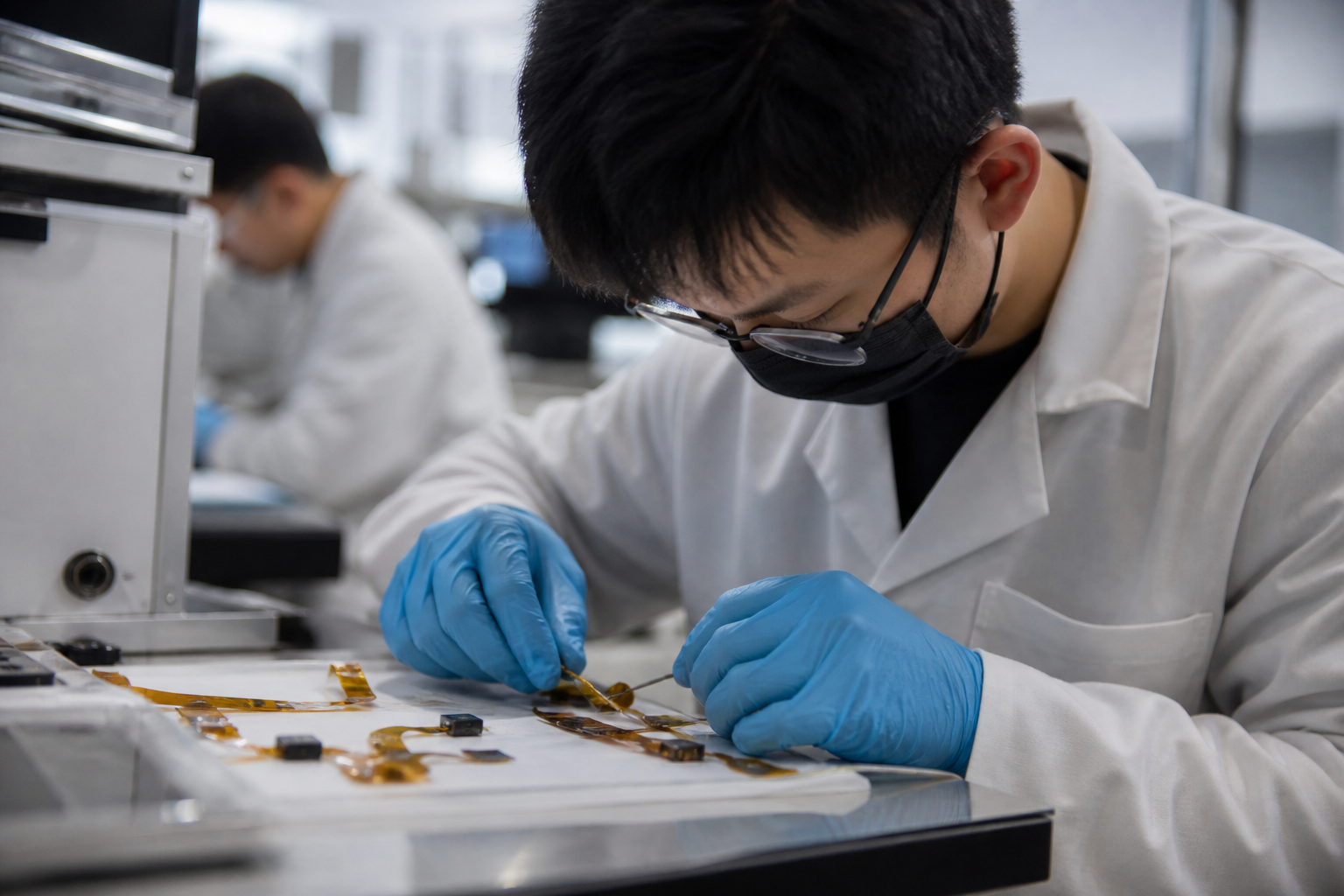
Soft Electronics and AI Are Converging Into Intelligent Systems That Sense Like Living Tissue
Soft electronics are entering their intelligent era
Flexible circuits that can bend, stretch and wrap around irregular shapes have moved from laboratory curiosities to serious candidates for next-generation wearable, biomedical and human-machine interface devices. The next step is not simply making them more elastic. A new wave of research is focusing on how advanced soft materials, scalable manufacturing and hardware architectures can work together to create systems that do not just flex, but also sense, process and respond more like living tissue.
The convergence is subtle but consequential. For years, soft electronics and artificial intelligence have progressed along largely separate tracks. Now researchers are examining what happens when those tracks merge: hardware that can collect high-fidelity biological or environmental signals while remaining mechanically compliant, and AI-enabled processing that can turn those signals into adaptive action.
The materials foundation is only the beginning
Advanced soft materials remain central to the field. Stretchable conductors, flexible substrates and conformable sensors allow electronics to maintain function under deformation, opening up surfaces that rigid silicon cannot easily address. But the integration challenge is not limited to materials chemistry. A device that works in a single lab demonstration may fail when manufactured repeatedly or when asked to preserve signal quality across thousands of bending cycles.
Researchers increasingly describe the problem as a full-stack challenge. Materials, manufacturing methods and hardware architecture must be designed together. A promising conductor that is difficult to deposit uniformly, or a soft sensor that drifts under strain, cannot automatically become a reliable intelligent system. The field is therefore moving toward co-design, where material choices are evaluated alongside circuit layouts, packaging approaches and the signal-processing chain.
High-fidelity signal acquisition is the real bottleneck
One requirement stands out: high-fidelity signal acquisition and processing. If soft electronics are to support intelligent sensing and AI-driven functions, they cannot simply produce a readable output. They must preserve the fine detail of the underlying signal, whether that is a subtle electrophysiological change, a mechanical strain pattern or a temperature gradient, without adding noise or distortion from the flexible interface itself.
This is harder than it sounds. Soft materials are often less electrically stable than rigid counterparts, and deformation can alter resistance, capacitance or contact quality. The review points to the need for hardware architectures that compensate for these variations while keeping signals clean enough for downstream AI models. Without that fidelity, even the most sophisticated algorithms have little useful information to learn from.
From passive flexible devices to adaptive intelligent systems
The shift under way is not merely from rigid to flexible. It is from passive to adaptive. Early flexible electronics focused on proving that circuits could bend and still operate. The emerging goal is to build systems that use sensing and computation to adjust their behaviour in real time, closer to how biological tissues respond to changing conditions.
That ambition places the field at the intersection of soft electronics and artificial intelligence. Such systems could eventually support wearable monitors that track physiological signals with clinical-grade precision, biomedical interfaces that conform to soft tissue, or human-machine interfaces that translate muscle and neural activity into control commands. However, experts caution that many applications remain at the research stage and need further validation before they can be described as ready for real-world deployment.
Scalable manufacturing is a priority, not an afterthought
Scalable manufacturing is emerging as a key priority. Lab prototypes can be hand-assembled, tuned individually and tested under ideal conditions. Translation into reliable, reproducible hardware requires processes that can maintain performance across batches, device sizes and use cases.
That includes printing and patterning techniques, quality control for soft materials, and packaging that protects electronics without sacrificing flexibility. The central question is no longer whether a device can work once. It is whether it can be produced consistently and still deliver the signal fidelity that intelligent systems require.
For more background on the materials and device engineering questions shaping this space, see Nature Reviews Materials and IEEE Spectrum.
Why the convergence matters
The broader significance lies in next-generation technologies that need electronics to disappear into clothing, skin patches, surgical tools or robotic surfaces while still providing reliable, intelligent function. That requires a rare kind of engineering discipline: one that treats material softness, manufacturing repeatability and AI readiness as part of the same design problem.
If researchers can solve that integration challenge, the result may be a new class of devices that feel less like hard machines attached to the body and more like responsive, adaptive systems embedded in the environment. The path from advanced soft materials to intelligent systems is not a single breakthrough but a coordinated climb across the entire hardware stack.