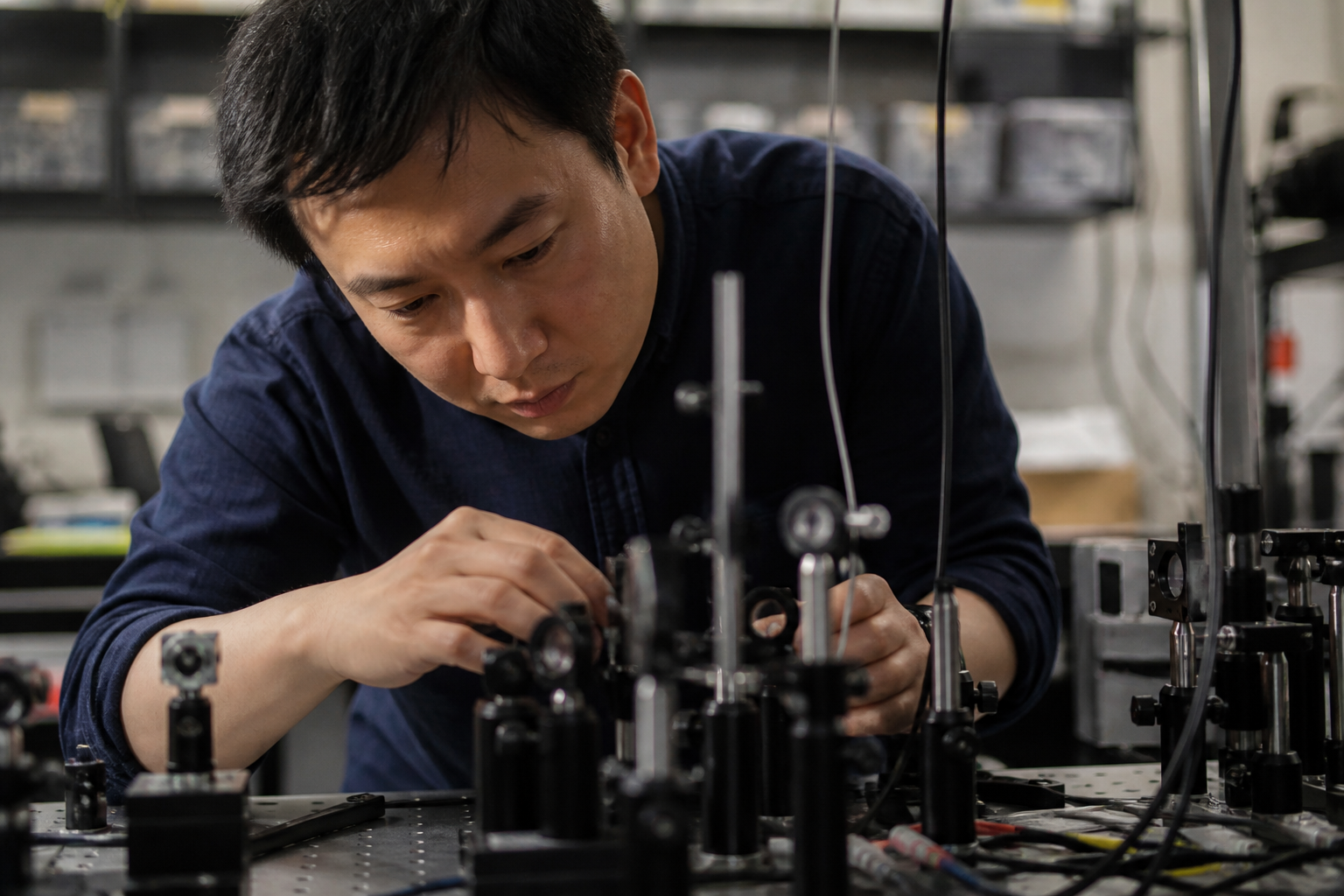
A Northeastern Engineer Is Using Light to Break AI’s Energy Bottleneck
The power problem behind modern AI
Artificial intelligence is frequently described as a software revolution, but its next major obstacle may be physical. Training large machine-learning systems and running them at scale require huge amounts of electricity. Data centers that host AI workloads must also remove enormous quantities of heat, making power and cooling capacity a central concern for the industry.
A Northeastern University engineer is exploring a different way to address that demand: using light instead of conventional electronics to process information. The research sits at the intersection of AI infrastructure, semiconductor design, and photonics, and it reframes energy efficiency as a hardware problem rather than only a software one.
Photonics as an efficiency play
Photonics is the science of generating, controlling, and detecting light. In computing, photonic approaches are attractive because optical signals can carry information without the same resistive heating and electrical losses that burden electronic circuits. For AI applications, where repeated matrix operations move massive amounts of data, those losses add up quickly.
Peer-reviewed research in photonics has long explored light-based information processing, and the Northeastern engineer’s work focuses on a specific tool: metasurfaces. These are engineered surfaces that can manipulate light in highly controlled ways. Rather than relying on bulky lenses or complex optical setups, metasurfaces can shape light in thin, compact layers. That matters for AI hardware because it could open the door to low-power optical processors small enough for practical systems.
Less about speed, more about sustainability
The goal is not simply faster computation. The broader ambition is to reduce the energy footprint of AI data centers and edge devices. If light-based components can handle parts of a machine-learning workload with less electricity and less heat, they could ease the strain on power grids and cooling infrastructure even if raw speed is not the primary gain.
That perspective is part of a wider movement in hardware-for-AI research, where academic and industry teams are looking beyond conventional silicon-only approaches. Photonics, analog computing, and new memory technologies are all being studied as ways to keep AI capabilities growing without consuming unsustainable amounts of power.
Why it matters
- AI training and inference already place heavy demands on electricity and cooling.
- Light-based processing could reduce energy lost as heat.
- Metasurfaces may enable compact optical hardware for data centers and edge devices.
- The work is early-stage, pointing to long-term potential rather than near-term deployment.
The current limits
The research remains firmly in the lab. It is not a commercial solution, and no claim is being made that photonic metasurfaces are ready to replace today’s AI accelerators. Translating optical computing concepts into reliable, manufacturable hardware is difficult, and many promising photonic ideas have struggled to scale.
Still, the direction reflects a growing recognition that AI’s future depends on more than model size. As data center electricity use rises, government and industry attention is turning toward efficiency. The U.S. Department of Energy tracks data center energy efficiency, and AI workloads are part of that conversation.
What comes next
If photonic metasurfaces continue to mature, they could become one piece of a more energy-conscious AI infrastructure. The nearer-term impact, however, is in the research agenda: proving that light-based hardware can handle meaningful machine-learning tasks while using less power.
For now, the Northeastern engineer’s work offers a new way to see AI’s power constraints — literally through the behavior of light.