World Humanoid Robot Games Conclude in Beijing, Mixing High Tech with Human Warmth
The third edition of the World Humanoid Robot Games drew to a close in Beijing on Wednesday, August 26, 2026, capping a week of cutting-edge competitions that pitted advanced humanoid machines against one another in tests of agility, intelligence, and endurance. The games, which have rapidly become a focal point for the global robotics community, blended moments of pure engineering triumph with a distinctly human touch—most visibly during a closing ceremony that featured a performance by local children.
A Global Stage for Robotics
Held at the Beijing National Convention Center, the World Humanoid Robot Games brought together teams from universities, research labs, and private companies across more than a dozen countries. While the event has roots in academic robotics challenges, its profile has surged in recent years as bipedal and humanoid platforms have grown dramatically more capable. This year’s edition expanded into new categories, including full-body task execution, dynamic obstacle navigation, and even a robot triathlon that mirrored the multi-discipline format of a human decathlon.
Observers noted that the machines on display—some standing over five feet tall and weighing upwards of 130 pounds—moved with a smoothness and stability that were unimaginable just a few years ago. Advances in actuator technology, machine learning–driven balance control, and lightweight composite materials were on full display, allowing robots to jog, climb stairs, open doors, and manipulate delicate objects with near-human dexterity.
The competitive format itself is seen as a powerful accelerator for the field. By creating clear, measurable milestones—fastest sprint, highest jump, most accurate object retrieval—the games push teams to solve real-world problems that robots would face in factories, hospitals, and homes. “Every spin, every tumble, and every successful backflip is a data point that drives the whole industry forward,” one attending researcher commented in a post-event briefing.
Children Bring Human Touch to High-Tech Farewell
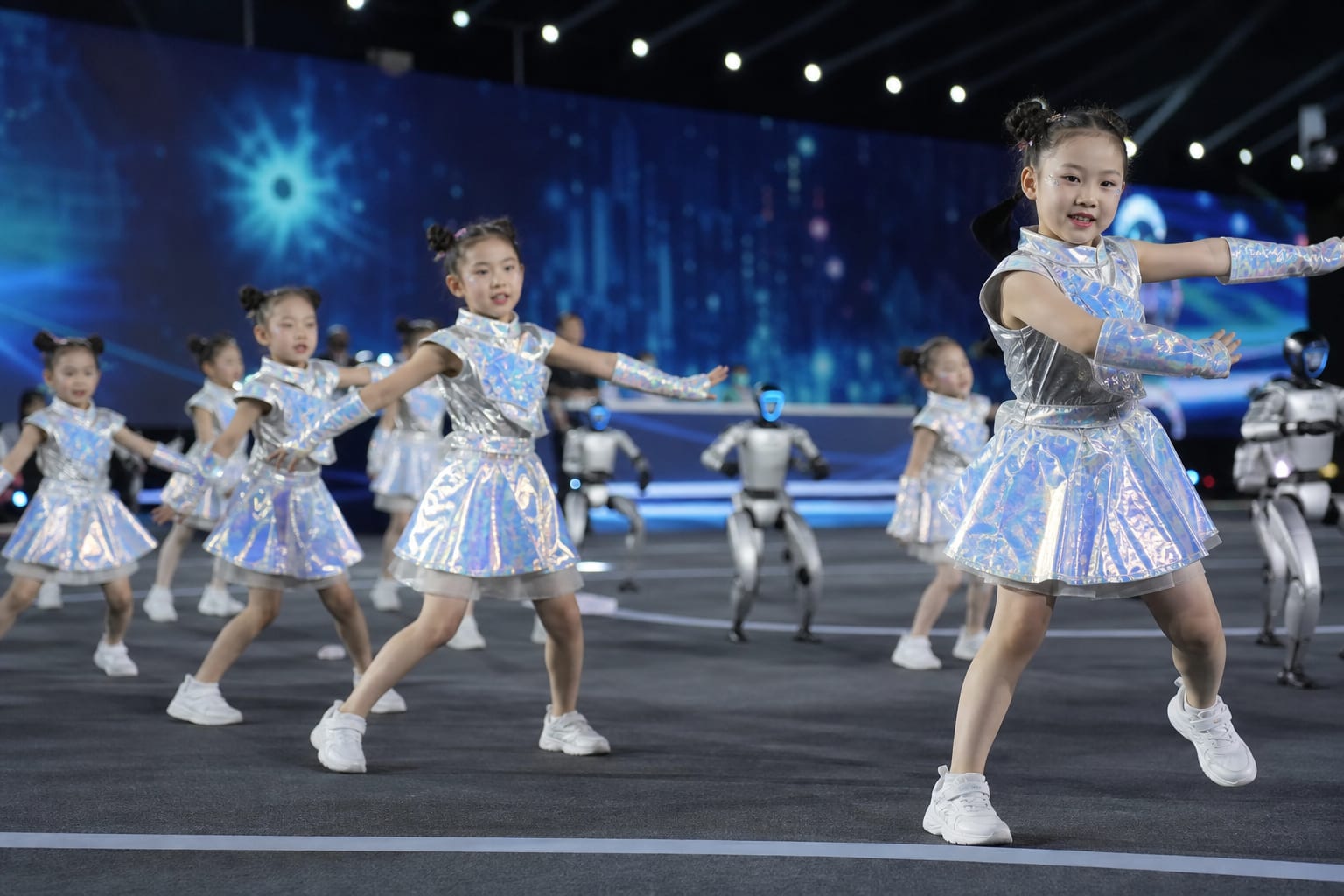
While the main arena had spent days echoing with the whir of servomotors and the clatter of mechanical feet, the closing ceremony shifted the mood. As captured by an Associated Press photographer, a group of young performers from a Beijing children’s arts troupe took to the stage, their synchronized dance and song providing a poignant counterpoint to the regimented movements of the machines that had dominated the headlines. The image of children dancing amid towering LED screens displaying robot silhouettes quickly became one of the defining visuals of the 2026 Games.
The choice to place children at the center of the finale was deliberate, organizers suggested later. It underscored the notion that humanoid robots are ultimately being developed not only to replace human labor but to enrich human life—assisting the elderly, educating the young, and collaborating in ways that blend technical prowess with social understanding.
For the robots themselves, the ceremonies provided a rare moment of rest. Many of the top-performing machines were displayed in static “parade” formations along the edge of the auditorium, their LED facial expressions programmed to smile, wink, or simply stare with a curious blankness that prompted both laughter and thoughtful silence among the audience.
China’s Push for Robotics Dominance
Beijing’s role as host city is far from incidental. China has declared robotics—particularly humanoid robotics—a strategic priority under its latest five-year plan and has poured billions of yuan into research clusters, startup subsidies, and talent pipelines. The World Humanoid Robot Games, first held in 2024, were conceived in part as a showcase for domestic innovation, and this year’s event did not disappoint on that front.
Chinese teams secured top-three finishes in multiple categories, including the bipedal sprint and the block-stacking relay, reinforcing the country’s growing reputation as a legitimate powerhouse in embodied AI. The government-backed Beijing Humanoid Robot Innovation Center, which served as co-organizer, used the platform to unveil new open-source software libraries aimed at standardizing robot training protocols worldwide—a move that could shape the competitive landscape for years to come.
The games also served as a testing ground for robots designed to operate in extreme environments, with one Chinese entry demonstrating a model capable of righting itself after simulated earthquake tremors and navigating through simulated rubble. Such developments have clear dual-use applications, though organizers emphasized the peaceful, collaborative spirit of the event.
Looking ahead, the future of the World Humanoid Robot Games appears bright. Plans are already under discussion to expand the next edition to include fully autonomous outdoor navigation challenges and a “robot soccer” tournament on a regulation-size pitch. For now, the closing ceremony’s blend of youthful energy and robotic precision offers a fitting snapshot of an industry that is still learning to walk—but already dreaming of running.