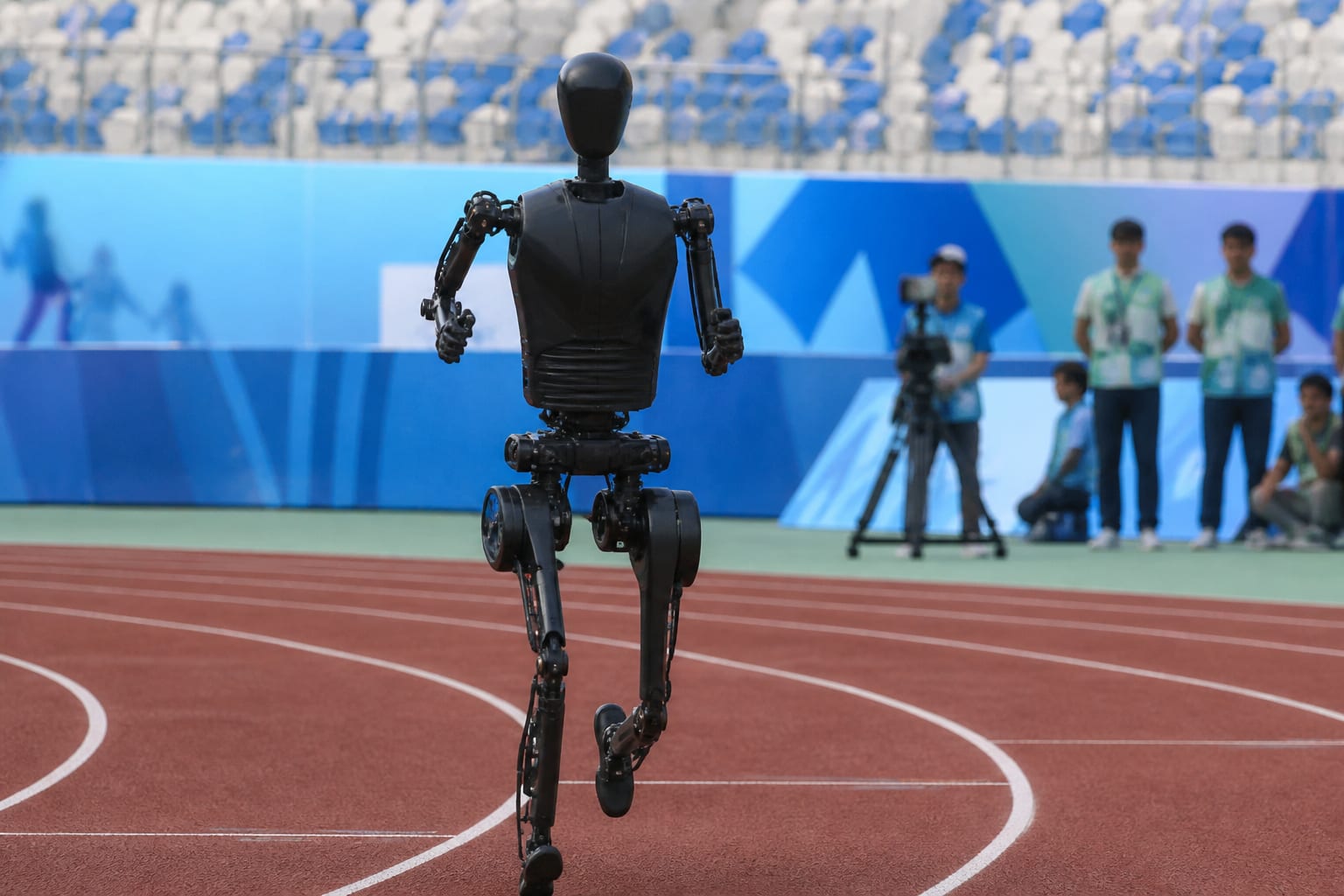
Chinese Humanoid Robot Clocks 8.86-Second 100-Meter Sprint at Beijing Games
A New Sprint Record
A Chinese humanoid robot has set a groundbreaking 100-meter sprint record of 8.86 seconds during the World Humanoid Robot Games in Beijing, marking a new milestone in bipedal robotics. The run took place on Tuesday and was immediately hailed by organizers as a new benchmark for humanoid speed.
The sprint, part of a series of athletic and agility demonstrations, showcased rapid advances in balance, leg coordination, and real-time movement control. At 8.86 seconds, the robot’s time not only surpasses previous humanoid clockings—many of which hovered above 10 seconds—but also edges closer to elite human performance. For context, the fastest human 100-meter dash remains Usain Bolt’s 9.58 seconds set in 2009, though experts caution that direct comparisons are limited by fundamental mechanical and rule differences.
Robotics as National Priority
The achievement arrives amid a broader push by China to lead in artificial intelligence and advanced hardware. The World Humanoid Robot Games have become a high-profile stage for domestic companies and research labs to showcase their latest prototypes, from agile quadruped robots to full-body humanoid platforms capable of running, jumping, and manipulating objects.
While the exact model and its manufacturer were not immediately disclosed, the run reinforces Beijing’s ambitions to tackle the immense engineering challenges of bipedal locomotion—problems that have long perplexed the global robotics community. The feat signals that humanoid robots are evolving from laboratory curiosities into systems with real-world balance and speed, potentially paving the way for applications in search and rescue, industrial inspection, and service sectors.
Technical Milestones and Open Questions
The 8.86-second dash required the robot to stay upright, accelerate smoothly, and maintain lateral stability over 100 meters—a test of both hardware durability and software algorithms. Unlike wheeled or tracked robots, humanoid runners must continuously adjust torque and foot placement in milliseconds, mimicking human gait while contending with uneven surfaces and momentum shifts.
Key details about the record, such as whether it was set in an official competition category or a demonstration run, remain to be clarified. The event rules, robot class restrictions, and course setup—including any starting mechanisms or allowed assists—will determine whether the performance becomes an officially ratified world record within the humanoid robotics community.
What Comes Next
The sprint record is likely to fuel both enthusiasm and scrutiny. Robotics firms worldwide will now have a tangible target to beat, while regulators and ethicists may raise new questions about the safety and deployment of fast-moving humanoid machines in public spaces.
As the World Humanoid Robot Games continue in Beijing, additional events—from obstacle courses to dexterity challenges—are expected to further highlight how China’s robot builders are pushing the boundaries. For now, the 8.86-second mark stands as a vivid reminder that humanoid robots are not just walking; they are running into the future.