Tiny Chip, Big Ambition: Running Generative AI on the RP2350
A growing number of developers and hobbyists is questioning whether artificial intelligence always needs to live in the cloud. Driven by a desire for privacy, offline access, customization, and lower recurring costs, the search for local AI models is now reaching some of the smallest computing devices ever made. One of the most striking recent examples involves the RP2350, a low-cost microcontroller that was never designed to run generative AI.
On such constrained hardware, the result is not a mainstream AI replacement. It is a technical proof of concept, and it highlights how far model compression and simplified inference can be pushed when engineers treat every byte of memory as precious.
Why Local AI Is Gaining Attention
Cloud-based AI services are convenient, but they come with tradeoffs. Users who want to keep sensitive prompts or sensor data on their own devices are looking for ways to run models without sending information to external servers. Offline use is another factor: a local model works in remote locations, inside secure facilities, or wherever connectivity is unreliable. Customization also matters: a maker or business may want a model tuned for a narrow task rather than a general-purpose system. Finally, local inference can reduce recurring API and subscription costs, especially for high-volume or always-on applications.
The RP2350: An Unlikely AI Platform
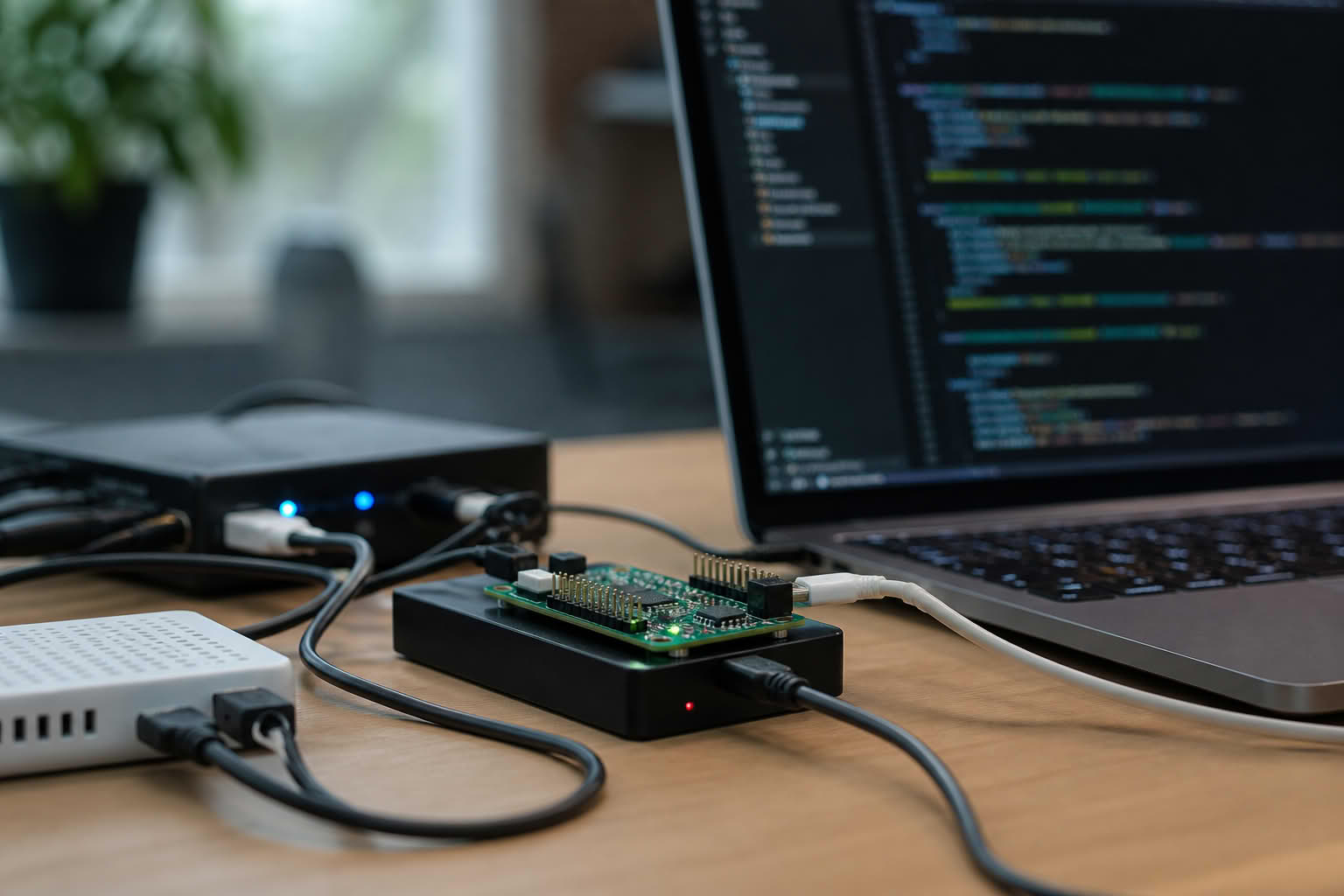
The RP2350 is a small, low-power microcontroller in Raspberry Pi’s embedded lineup. It is the kind of chip used in compact hardware projects, sensor hubs, and educational devices, not a data-center accelerator. Its documentation emphasizes its flexibility for embedded work, but memory, compute, and storage are extremely limited compared with the GPUs or NPUs typically used for generative AI.
That is precisely why a generative AI demonstration on this class of hardware is notable. It is not evidence that microcontrollers will replace dedicated AI chips; rather, it shows that the boundary of what is possible keeps moving, even on devices that fit in the palm of a hand.
What “Running AI” Actually Means Here
Generative models are usually resource-hungry. Large language models and image generators require substantial memory to hold model weights, fast compute to produce output in a reasonable time, and enough storage to store the model itself. On an embedded device, all three resources are scarce.
That means the output from an RP2350 demo is generally modest. Instead of fluent multi-paragraph responses or high-resolution images, users can expect short text completions, heavily simplified sequences, or other effects constrained by a tiny model and slow inference. The value is not raw capability but the techniques used to make any generative output possible at all.
Efficiency and Optimization Are the Real Story
The broader edge-AI movement has long focused on making models smaller and more efficient. Work on quantization, pruning, and distilled or heavily simplified architectures has already helped AI run on smartphones and single-board computers. The RP2350 experiment sits at the extreme end of that spectrum: embedded systems, hobbyist experimentation, and edge inference meeting in a single low-power chip.
On a microcontroller this small, every kilobyte of memory and every milliwatt of power matters.
Because of those constraints, the likely significance lies in optimization methods rather than performance. A demonstration that squeezes a generative model into a microcontroller can teach the wider community how to reduce overhead, simplify inference, and make local AI more practical on other low-power devices. Resources from Hugging Face’s edge and local inference documentation explore similar themes around model compression and on-device deployment.
Practical Use Cases and Limitations
For hobbyists and privacy-conscious users, the appeal is understandable. Local AI on extremely cheap hardware could support simple offline text generation, educational experiments, or small always-on assistants that do not send data to the cloud. However, the limitations are just as clear:
- Very small memory limits the size and complexity of the model.
- Slow inference speed makes interactive or high-volume use impractical.
- Output quality is far below what cloud services or larger local machines can produce.
- Energy and storage constraints require aggressive optimization and simplification.
These tradeoffs mean the RP2350 is unlikely to become a daily driver for generative AI. Its real importance is as a demonstration that local, private, custom AI can keep moving toward smaller and cheaper hardware, challenging assumptions about how much computing power is truly necessary.