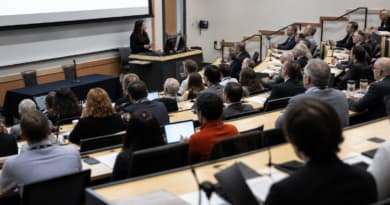
Dartmouth’s ‘AI at 70’ Conference to Revisit the Birth of Artificial Intelligence with a Focus on Human Judgment
Dartmouth to Host Landmark Gathering at AI’s Birthplace
Seven decades after a small group of researchers gathered in Hanover, New Hampshire, and launched the field of artificial intelligence, Dartmouth College is preparing to host a major conference that will not only celebrate that legacy but also center a decidedly human question: what role should human judgment play in an age of increasingly autonomous machines? The event, called “AI at 70,” is scheduled for this October and marks the 70th anniversary of the legendary 1956 Dartmouth Summer Research Project on Artificial Intelligence — widely credited as the foundational moment that gave the discipline its name and its earliest ambitions.
Rather than a simple retrospective, the university’s framing suggests a conference designed to probe the uneasy intersection between rapid technological progress and the limits of human control. Early promotional materials from Dartmouth emphasize “a focus on human judgment,” signaling that the event will examine not just AI’s history and current capabilities, but also the vital importance of oversight, accountability, and the decisions that shape both the design and deployment of intelligent systems.
A Look Back at the 1956 Summer Research Project
In the summer of 1956, John McCarthy, Marvin Minsky, Nathaniel Rochester, and Claude Shannon convened a six-week workshop at Dartmouth with a daring proposal: “every aspect of learning or any other feature of intelligence can in principle be so precisely described that a machine can be made to simulate it.” That gathering is universally recognized as the moment when “artificial intelligence” was officially born as an academic field, setting the stage for decades of research into neural networks, symbolic reasoning, robotics, and later the explosion of machine learning.
The upcoming “AI at 70” conference will likely revisit that audacious original vision and compare it with the present reality, where large language models, computer vision, and generative AI have far surpassed the early researchers’ dreams — yet also raised deep concerns about bias, safety, and the erosion of human agency.
AI at 70: A Conference for the Age of Generative AI
Dartmouth has not yet released a full list of speakers or partner institutions, but the thematic emphasis on human judgment suggests the program will blend academic research, historical reflection, and public policy. Organizers appear intent on moving beyond purely technical celebration to address the governance questions that now dominate headlines — from algorithmic discrimination to the use of AI in warfare, healthcare, and criminal justice.
Expected areas of discussion include:
- The historical legacy of the 1956 project and how its aspirations evolved
- Current breakthroughs in generative AI and their societal impact
- The responsibility of researchers and companies in constraining AI systems
- Policy frameworks for human-in-the-loop decision-making
- The ethical limits of automation when human lives are at stake
Given the location — the very campus where AI was first conceived — the conference carries symbolic weight. It positions Dartmouth not only as the birthplace of a technology that now touches every aspect of modern life but also as a critical voice in the debate about its future.
Why Human Judgment Matters Now More Than Ever
The choice to highlight human judgment comes as regulators, civil society groups, and even some technologists warn that AI development is outstripping society’s ability to manage it responsibly. The past two years have seen a cascade of breakthroughs in generative models capable of producing convincing text, images, and code, often with minimal transparency about training data or potential misuse. In this climate, the question of how human judgment is embedded — or bypassed — in AI pipelines has become a central concern alongside technical performance.
By framing the anniversary around this theme, Dartmouth appears to acknowledge that the next chapter of AI must be as much about philosophy, law, and ethics as it is about algorithms. The conference could serve as a platform for academics, policymakers, and industry leaders to chart a course that keeps human responsibility at the core of intelligent systems, a message that resonates far beyond the campus in New England.
As the October event approaches, more details are expected to emerge regarding specific panels and participants. For now, the signal is clear: at the very spot where AI was born, the conversation is shifting from what machines can do to what humans should allow.