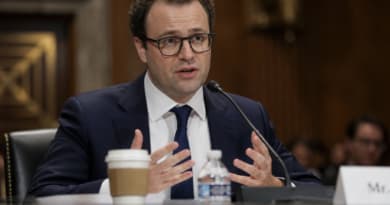
Chip Roy Issues Urgent AI Warning on His Way Out of Congress
Texas Representative Chip Roy, one of the House’s most unyielding conservative voices, is set to leave Congress. But rather than deliver a standard partisan farewell, the hardliner is using his final moments on the Hill to plead with colleagues to confront a threat he believes lawmakers have dangerously ignored: artificial intelligence.
Roy, a Freedom Caucus stalwart known for his fierce opposition to government overreach and regulation, surprised many when he revealed he is now “wrestling with what the advent of artificial intelligence could mean for life.” The comment marks a striking departure for a politician who has spent his career championing minimal federal intervention.
“I’m wrestling with what the advent of artificial intelligence could mean for life — how we work, how we communicate, what it means for truth itself,” Roy said recently, according to a person familiar with his remarks.
His warning spans the full spectrum of AI risk, from economic upheaval driven by automation to the erosion of democratic norms through synthetic media and deepfakes. He is said to be equally concerned about AI’s potential use in autonomous weapons and the weaponization of misinformation, describing the technology as a force that will reshape national security and social stability faster than Washington can act.
Roy’s particular brand of conservatism — fiercely libertarian on economic matters, hawkish on government power — had long placed him opposite calls for tight regulation of emerging technologies. For him to now emphasize the need for legislative seriousness about AI underscores how profoundly the technology’s trajectory has scrambled traditional ideological lines. While many on the left have pushed for strict oversight, Roy’s warning suggests a segment of the right is increasingly worried that the absence of any guardrails could itself threaten individual liberty and free markets.
“This isn’t a call for a massive new bureaucracy,” an aide familiar with his thinking said, describing Roy’s approach as a recognition that “the speed and opacity of AI development mean a purely hands-off approach is no longer viable.” The congressman has reportedly pointed to labor disruption — AI’s capacity to replace jobs not in some distant future but within years — as well as the integrity of elections and public discourse.
Roy’s departure at the end of his term gives his words the weight of a legacy statement rather than a legislative maneuver. He wants his Republican colleagues, and the institution broadly, to grapple with AI now, before technical capability far outstrips any policy framework. The warning arrives as Congress continues to dither on comprehensive AI legislation, with hearings producing substantial rhetoric but little binding law.
The political backdrop heightens the significance of Roy’s stance. For years, GOP leadership has been wary of tech regulation, often framing it as censorship under another name. Roy’s dissent — from the party’s own hardline, deregulatory wing — may foreshadow a broader re‑evaluation. Already, a handful of conservatives have expressed alarm over unchecked algorithmic influence, AI‑generated child exploitation material, and the national security implications of adversaries exploiting open‑source models.
Policy analysts note that Roy’s warning aligns, in some respects, with the federal government’s own risk assessments. The National Institute of Standards and Technology has published an AI Risk Management Framework that flags many of the same dangers — bias, disinformation, workforce displacement — and urges a measured, iterative regulatory approach. Roy’s challenge to his party may be to accept that some level of governance is not a betrayal of conservative principles but a defense of them.
Observers inside the Capitol say the spectacle of Roy, a man rarely willing to cede ground, pushing his own caucus to take AI seriously may shake loose a new conversation. “He’s leaving, so he has nothing to lose,” one senior House aide noted. “When a conservative firebrand says the state needs to be clear-eyed about a threat, people listen — even if they don’t want to.”
Roy himself has framed the issue as a matter of existential prudence, not big government. In private conversations, he has drawn parallels to the dawn of the nuclear age, when Congress had to quickly develop institutions and norms to manage a transformative and dangerous technology. AI, he suggests, could prove even more destabilizing because its effects are diffuse, invisible, and self‑accelerating.
For now, his parting message is simple: wake up. The speed of AI development, fueled by hundreds of billions in private investment and intense international competition, is not waiting for Washington’s notoriously slow deliberative process. Whether Roy’s colleagues will hear his warning as a call to pragmatic oversight or as a political inconvenience remains to be seen. But by speaking out as he walks out the door, the Texas Republican has ensured that the AI alarm is no longer coming only from the usual suspects.