
Cleveland Residents Treated to Striking Partial Lunar Eclipse on Friday Night
Cleveland Residents Treated to Striking Partial Lunar Eclipse on Friday Night
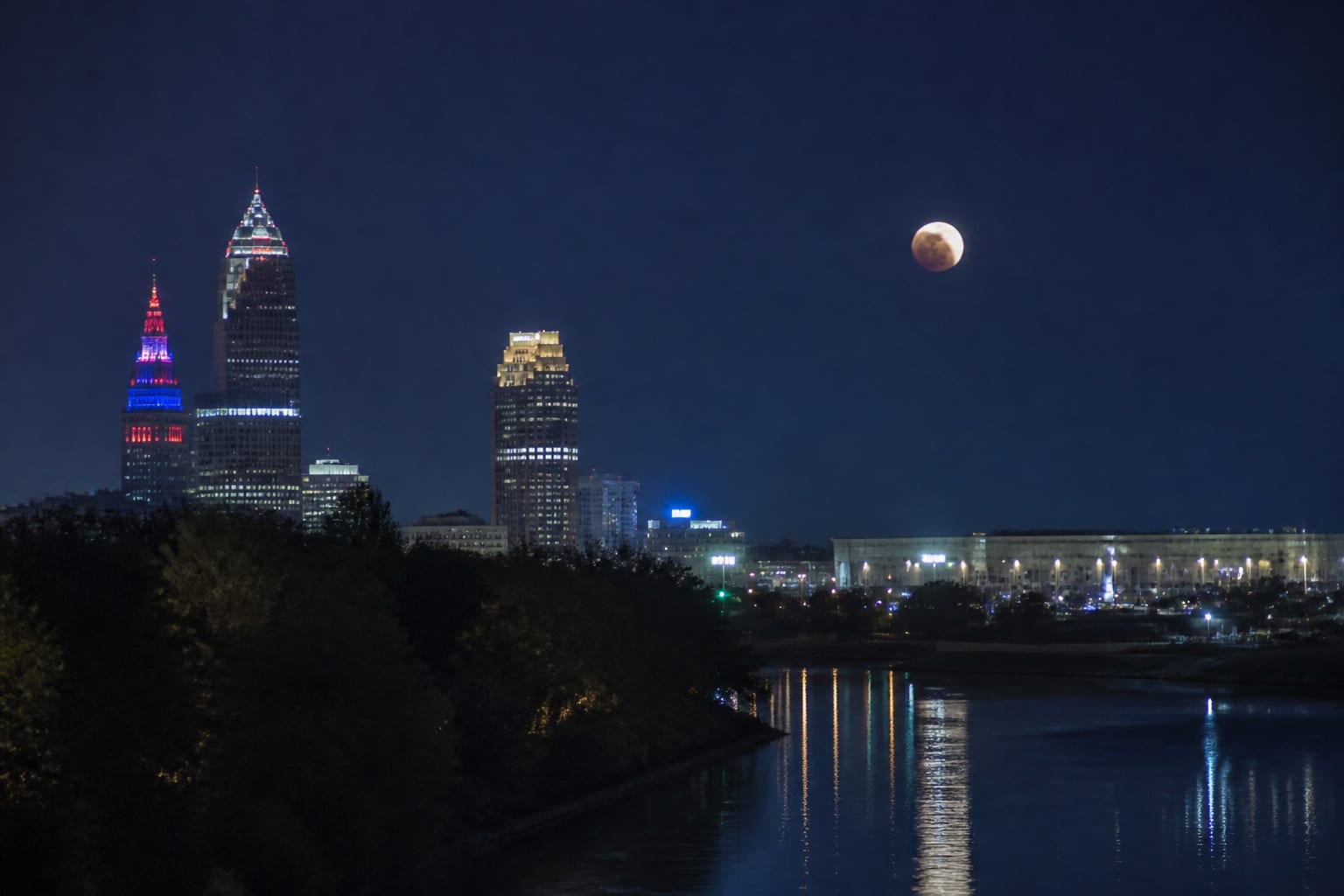
A visually striking partial lunar eclipse was visible over Cleveland on Friday, Aug. 28, 2026, offering local skywatchers a memorable celestial display. The event was documented in a photograph taken in the city, showing part of the Moon passing through Earth’s shadow.
The image, credited to Associated Press photographer Carolyn Kaster, captures a local view of a broader astronomical occurrence. Rather than a breaking event with direct safety or emergency impacts, the eclipse served as a nighttime skywatching moment for residents in Northeast Ohio and beyond.
What Happened in the Sky
A partial lunar eclipse occurs when only a portion of the Moon enters the darkest part of Earth’s shadow, known as the umbra. Unlike a total lunar eclipse, in which the entire lunar disk can take on a reddish hue, a partial eclipse leaves part of the Moon fully illuminated while another section appears darkened. The result often creates a subtle but noticeable bite-like shadow across the lunar surface.
Friday’s event was visible to the naked eye where skies were clear, and no special equipment was required to observe it safely. Because lunar eclipses involve the Moon rather than the Sun, they do not require protective eyewear, distinguishing them from solar eclipses.
A Local Angle on a Broader Astronomical Event
The Cleveland sighting was part of a wider viewing zone in which the eclipse could be observed across multiple regions, depending on local weather and timing. While this particular news angle focused on Cleveland, residents in nearby areas with clear nighttime conditions may also have seen the Moon’s partial dimming.
For those who missed the event or want to track future occurrences, NASA maintains dedicated eclipse resources that explain how lunar eclipses form and provide schedules for upcoming events. Time and Date also offers detailed global coverage of lunar and solar eclipses, including visibility maps and timing charts. The U.S. Naval Observatory’s astronomical applications page serves as another authoritative reference for celestial event data.
Skywatching, Not a Safety Story
Officials and astronomers emphasize that a partial lunar eclipse is strictly a natural astronomical event rather than a safety or emergency situation. Unlike severe weather or other urgent news, eclipses provide an opportunity for education and public engagement with science.
Astronomy enthusiasts often use events like Friday’s partial eclipse to introduce newcomers to lunar observation. Even a modest pair of binoculars can enhance the view by revealing the uneven edge of Earth’s shadow as it crosses the Moon’s craters and maria.
A partial lunar eclipse is a gentle reminder of the predictable motion of celestial bodies, and it offers anyone a chance to look up and connect with the wider universe.
The AP photograph credited to Carolyn Kaster serves as the main documented evidence from the scene in Cleveland, illustrating how the eclipse appeared against the city’s nighttime backdrop. The image was distributed through wire services and picked up by outlets including WV News.
For Cleveland residents, Friday’s partial lunar eclipse marked a brief but notable moment in the summer sky. With future lunar eclipses already mapped on astronomical calendars, skywatchers can plan ahead for their next opportunity to watch Earth’s shadow sweep across the Moon.


