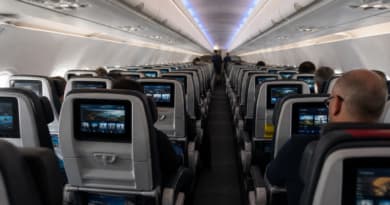
American Airlines to Bring 4K Seatback Screens to Every Seat, Add More Premium Rows
A Digital Overhaul at 35,000 Feet
American Airlines is betting big on cabin comfort and connectivity, announcing a sweeping fleetwide upgrade that will see seatback entertainment screens installed at every seat across its narrowbody fleet for the first time. The Fort Worth-based carrier will also significantly increase the number of premium seats on those same aircraft, aiming to capture more high-yield passengers as the industry’s product race intensifies. The multi-pronged initiative, which bundles 4K screens, high-speed Starlink Wi‑Fi and a denser premium layout, was detailed in a press release from the airline.
Entertainment at Every Seat
Until now, many of American’s narrowbody jets relied on passengers to stream content to their own devices, leaving a patchwork of in-flight entertainment availability. Under the new program, every seat – from first class to the last row of economy – will receive a high-definition 4K screen built into the seatback. The installation effectively ends the “bring your own device” era for the carrier’s single-aisle fleet, giving all travelers a consistent, cable-style viewing experience without draining personal batteries. The screens will be paired with an enhanced library of movies, TV shows, live television and games, although the airline has not yet detailed whether the content will be gate-to-gate or available only above 10,000 feet.
Premium Push and Connectivity
American’s narrowbody overhaul isn’t just about keeping passengers entertained. The airline confirmed it is increasing the number of premium seats throughout the fleet, adding more first-class recliners and extra-legroom Main Cabin Extra rows on Airbus A320-family and Boeing 737-family aircraft. The move responds to a clear post-pandemic trend: both corporate road warriors and premium leisure travelers are willing to pay a premium for more personal space and dedicated service, even on shorter domestic flights. By redesigning its cabins with more high-margin real estate, American can drive unit revenue growth on competitive hub-to-hub routes.
On the connectivity side, the airline is equipping all narrowbody jets with SpaceX’s Starlink high-speed, low-latency satellite internet. The system, already tested on some regional jets, promises streaming and video-call capability that rivals what passengers enjoy at home – a significant leap over the ground-to-air Wi‑Fi that has long been a source of frustration. Bundling Starlink with seatback screens gives American a dual-channel digital offering, allowing travelers to either lean back and watch a film or stay productive at high altitude.
American ups the ante at 35,000 feet with an integrated experience that blends premium seating, 4K entertainment and ultrafast Wi‑Fi.
Fleet Modernization and Market Strategy
The retrofit program covers the core of American’s domestic and short-haul international operations: the Airbus A319, A320 and A321, as well as the Boeing 737-800 and 737 MAX 8. Reworking hundreds of aircraft will take several years, and the airline will need to carefully manage the downtime so that it does not disrupt summer peaks or key business routes. Industry analysts expect the work to be timed with already planned heavy maintenance checks, though some frames may be pulled from service temporarily during off-peak periods.
The upgrade puts American on a more direct competitive footing with Delta Air Lines and United Airlines, both of which have long offered seatback screens on a large portion of their mainline narrowbodies. United, for example, already equips its 737 MAX fleet with 4K monitors and Bluetooth connectivity. By finally matching – and in some areas surpassing – its rivals, American may stem any quiet defection of tech-minded business travelers. The sheer scale of the investment also signals that the airline sees a durable shift in passenger expectations; free streaming and seat power are no longer differentiators but baseline requirements.
From a commercial standpoint, the denser premium configuration is arguably the more impactful change. Even a handful of additional first-class or extra-legroom seats per aircraft can generate millions of dollars in incremental annual revenue across a fleet of more than 900 narrowbody planes. With corporate travel budgets recovering and leisure demand for front-cabin comfort remaining strong, the timing appears favorable. The combined seatback-screen and premium-seat rollout is likely to be marketed aggressively as a customer-experience differentiator, reinforcing American’s brand promise of “a world of entertainment and comfort at every seat.”
What Passengers Can Expect
For the flying public, the changes will become visible gradually as retrofits cycle through the fleet. Early customers may notice the 4K screens and Starlink antenna installations appearing first on aircraft that already had in-flight entertainment systems, while older frames undergo more extensive rework. Once complete, the narrowbody experience will feel noticeably more like the widebody long-haul cabins that many travelers associate with American’s flagship A321T transcontinental service. By unifying its product line, the airline hopes to reduce the operational complexity of shuffling aircraft between routes and to deliver a consistent, modern experience that passengers have come to expect from a global carrier.