Ricky Ponting’s Radical US Cricket Pitch: ‘Don’t Call It Cricket’
An Aussie Legend’s Pitch to America: Make Cricket Feel Like Home
Ricky Ponting, a titan of Test cricket and one of Australia’s most successful captains, believes the key to unlocking the vast American sports market lies in a simple but radical piece of advice: don’t call it cricket. The man who led Australia to two World Cup titles and scored over 27,000 international runs now finds himself in an unusual role — as a potential global ambassador for a sport that still struggles to gain a toehold in the United States.
In a wide-ranging interview, Ponting laid out his vision for how the game he dominated for nearly two decades can finally resonate with American audiences. He argued that the very word “cricket” can be a barrier, conjuring images of a slow, complex pastime rather than the explosive, high-octane product that modern T20 leagues deliver.
The ‘Don’t Call It Cricket’ Strategy
Ponting’s central pitch is a lesson in marketing. He contends that introducing the sport through familiar American frameworks is essential. Rather than presenting a foreign discipline with arcane rules, he suggests drawing immediate parallels to baseball — highlighting the bat-and-ball duel, the home-run equivalent of a six, and the fast-paced, three-hour spectacle of a T20 match.
His approach is to strip away the alien vocabulary. Talk of “wickets,” “googlies,” and “silly mid-on” can wait; the first selling point should be the athleticism and drama that American audiences already love. By the time someone asks what the game is actually called, they might already be hooked. This method aims to bypass the intimidation factor that traditional cricket parlance often imposes on newcomers.
The strategy mirrors early efforts by football (soccer) to gain recognition in the U.S., though cricket faces an even steeper climb. The International Cricket Council has already invested heavily in the American market, with the U.S. co-hosting the 2024 men’s T20 World Cup and Major League Cricket drawing modest but growing crowds. While cricket retains a cult following among expat communities, a recent surge in T20 franchise leagues and the success of the co-hosted World Cup have generated fresh momentum. Ponting’s comments arrive at a pivotal moment, as influencers inside and outside the sport debate how to turn curiosity into sustained fandom.
Concerns Down Under: Australia’s Top-Order Woes
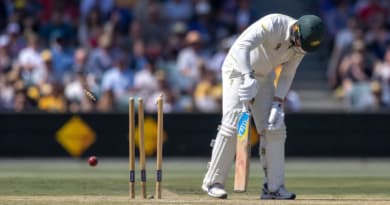
Away from the marketing playbook, Ponting did not shy away from a more personal concern: the state of Australian cricket’s famous top order. The former No.3 batsman expressed unease about the fragility that has crept into the national side’s opening partnerships and first-drop slot in Test matches. Without naming individuals, he pointed to a pattern of early collapses that has placed undue pressure on the middle order, a weakness he believes must be addressed ahead of future series.
For a man who forged an era of dominant Australian batting alongside the likes of Matthew Hayden and Justin Langer, the current instability represents a departure from the ruthless consistency that defined his own tenure. Ponting’s critique carries weight not only because of his 71 international centuries but because he was the anchor of a lineup that opponents rarely breached twice in a match.
The Man Behind ‘Clicky’
Woven throughout the conversation was the enduring nickname that has followed Ponting from his boyhood in Tasmania: “Clicky.” The moniker, reportedly derived from the distinctive sound his bat made striking the ball even as a junior, captures the natural timing that made him a prodigy. More than a trivial footnote, the nickname humanises the cricketing icon — a reminder that even the sport’s most intimidating competitors are built from childhood games and backyard heroics.
Ponting’s willingness to lean into that persona while discussing the game’s future adds a relatable layer to his advocacy. In a country where sports heroes are often forged in local parks and high school fields, the image of a young Ricky Ponting perfecting his click could serve as the very bridge he envisions for American families.
As cricket’s administrators continue to chase the American dream, Ponting’s voice — authoritative, approachable, and armed with a catchy mantra — may prove as effective as any six-hitting highlight reel. Whether the sport can truly become a mainstream American pastime remains an open question, but one of its greatest champions is ready to lead the pitch, one “flat-sided bat” at a time.