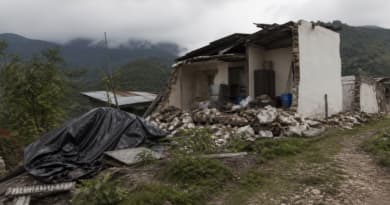
Strengthening state presence in Colombia’s conflict-affected territories
{“title”: “Colombia\u2019s President Bets on State Presence to Reclaim Conflict Zones, as Atlantic Council Warns Military Action Alone Is Not Enough”, “slug”: “colombia-state-presence-conflict-zones”, “content”: “
President Makes Territorial Control a Defining Priority
\n
Colombia\u2019s new president has placed the restoration of state authority in conflict-affected territories at the very centre of his administration\u2019s agenda, signalling a decisive break from years in which large stretches of the country were effectively governed by armed groups. The policy pivot, framed as a national security and governance imperative, comes as illegal organisations continue to compete violently for territory, local loyalty and the profits of illicit economies.
\n
A major Atlantic Council issue brief examines the scale of the challenge, cautioning that while a robust military deployment can temporarily shift the balance of power on the ground, sustainable control will depend on delivering what armed groups often replace: justice, policing, healthcare, education and a functioning local administration.
\n\n
Why the Periphery Matters
\n
For decades, Colombia\u2019s peripheries have been neglected by the central government. Dense jungles, vast plains and remote mountain ranges have allowed guerrilla movements, paramilitary successor networks and criminal bands to entrench themselves. These groups\u2014ranging from dissident FARC factions to the National Liberation Army (ELN) and Gulf Clan\u2014have built parallel systems of order, taxation and even dispute resolution, filling the vacuum left by an absent state.
\n
The Atlantic Council report notes that the resulting \u201ccontested peripheries\u201d are not simply a military problem. They represent a profound governance failure that has persisted despite the 2016 peace accord. As one analysis quoted in the brief observes, \u201cThe state cannot claim to exercise sovereignty if millions of citizens live under the de facto authority of illegal armed actors.\u201d
\n\n
More Than Troops: The State-Building Imperative
\n
Security experts distinguish between \u201cnegative\u201d state presence\u2014the ability of soldiers and police to remove or deter armed groups\u2014and \u201cpositive\u201d state presence, which involves the permanent delivery of public goods. The new administration\u2019s rhetoric, the brief notes, suggests an awareness of this distinction, but the real test will be implementation.
\n
The key pillars of a durable strategy would include:
\n
- \n
- Civilian policing and justice: Extending the reach of courts and prosecutors so that crimes are investigated and punished locally, breaking cycles of impunity.
- Basic services: Building or rehabilitating health clinics, schools and roads, often in areas where armed groups have been the primary service providers for years.
- Local governance: Supporting mayors\u2019 offices and community councils to reclaim administrative authority, countering the influence of illegal actors who co-opt local politics.
- Economic alternatives: Fostering legal livelihoods to undercut the recruitment base for armed groups reliant on coca cultivation, illegal mining or extortion.
\n
\n
\n
\n
\n\n
The Power-Vacuum Trap
\n
One of the most urgent warnings in the Atlantic Council analysis concerns what happens after a successful military operation. If the state pushes out an armed group but fails to establish a visible, credible presence, the result can be a chaotic reconfiguration of illegal power. Rival groups often rush in, sometimes triggering even more intense violence, while communities are left without protection.
\n
“The absence of the state is not merely a void; it is an invitation,” the brief argues, pointing to regions where territorial control has changed hands multiple times in recent years. Without a coordinated whole-of-government plan, short-term security gains can easily evaporate.
\n\n
Communities Caught in the Middle
\n
Local populations are the ultimate test of any state-building effort. In areas long dominated by armed actors, residents have developed intricate strategies for survival\u2014often involving accommodation, silence or even cooperation with the de facto authorities. Winning trust requires more than promises; it demands visible improvements in security, mobility and access to services that directly affect daily life.
\n
Human rights observers note that state absence is directly correlated with forced displacement, confinement of entire communities due to landmines or active combat, and severe restrictions on movement. For the president\u2019s vision to succeed, the government must convince these communities that a permanent civilian state presence is both possible and preferable to the precarious order imposed by armed groups.
\n\n
Is There a Coordinated Plan?
\n
The Atlantic Council report raises a critical question: whether Bogota has developed a truly integrated architecture that aligns the ministries of defence, interior, health, education and justice behind a single territorial strategy. Historically, interventions have been fragmented\u2014an army deployment here, a social programme there, without a cohesive timeline or shared benchmarks.
\n
A credible plan would need to sequence actions carefully, ensuring that as military units conduct clearing operations, civilian institutions are ready to move in immediately. It would also require sustained budget commitments, because state-building in neglected peripheries is measured in years, not electoral cycles.
\n\n
The Road Ahead
\n
Restoring state presence is as much a political and administrative challenge as it is a security one. The president\u2019s early emphasis suggests a genuine shift in priorities, but armed groups have decades of experience in filling the governance gaps that the central government now vows to close. Whether Colombia can finally translate territorial sovereignty from a constitutional aspiration into a lived reality for millions of its citizens will depend on the government\u2019s ability to deliver not just security, but the full spectrum of state services that make peace durable.
“, “category_name”: “Colombia”}