
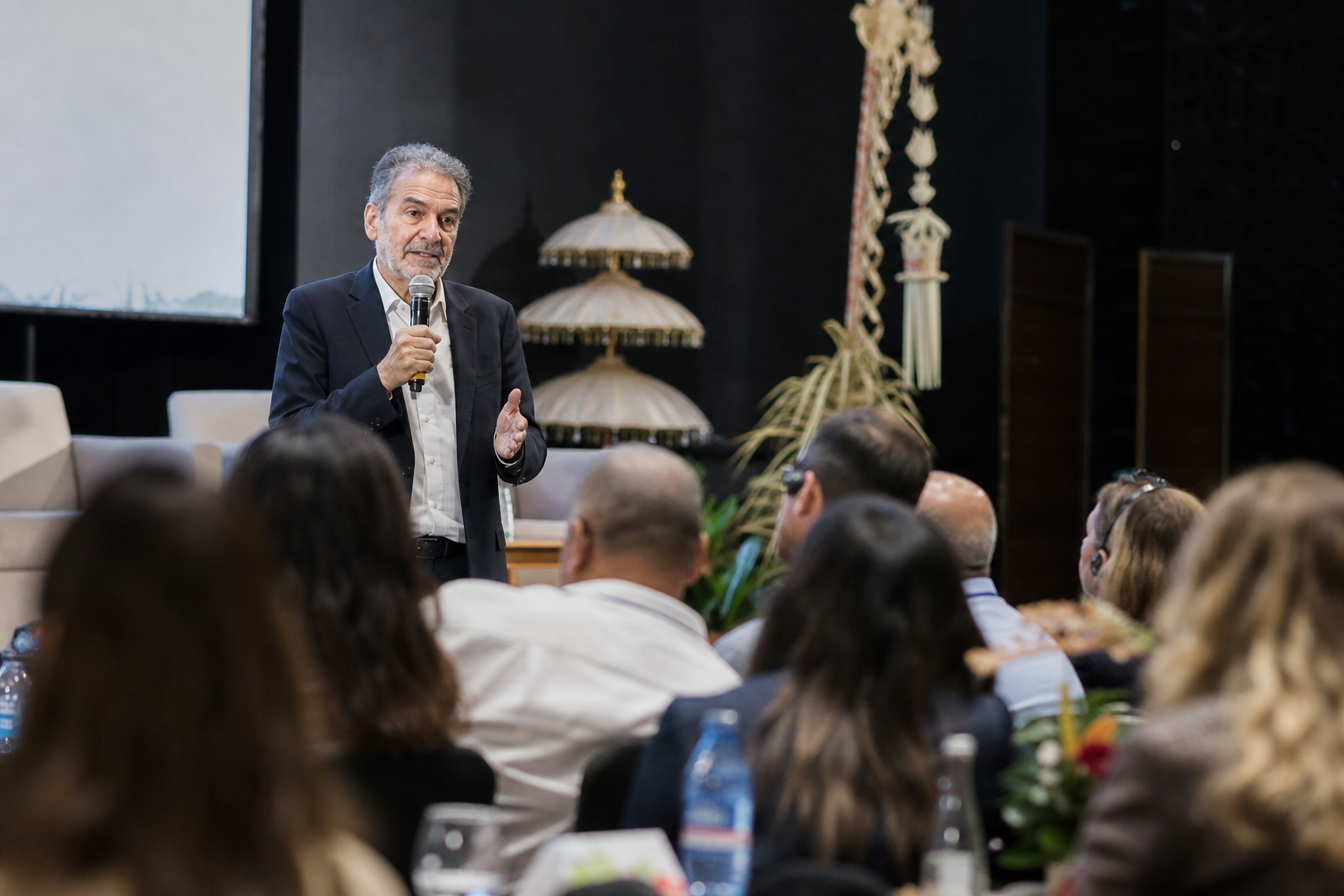
Are We Architects or Passengers? AI and the Crisis of Human Meaning Discussed at Bali Congress
A Question in Paradise
Against the backdrop of the Bali Campus, an international gathering of educators, students, and thought leaders convened for the XI International Scholas Chairs Congress, a single existential question eclipsed the technical chatter: Do we know the future we are creating? The query, posed not by a software engineer but by Italian intellectual Antonio Spadaro, cut to the heart of a global unease about the accelerating pace of artificial intelligence. The digital revolution, Spadaro argued in a recently published speech-essay, is no longer a question of code, but a fundamental crisis of human meaning.
Beyond Code and Computation
Spadaro’s address, disseminated via his Substack platform, deliberately reframed the global AI debate. Rather than fixating on productivity gains, algorithmic bias, or the mechanics of large language models, he redirected the spotlight onto interior human territory: identity, agency, and moral responsibility. In a congress hall filled with the energy of youth and the gravity of academia, the pressing issue was not whether machines can think, but whether humans are ceasing to mean.
The Scholas Chairs Congress, an initiative connected to Scholas Occurrentes, provides a unique crucible for this discussion. The movement, which links young people globally with a focus on education and encounter, treats technology not as a standalone subject but as a layer suffusing human formation. Within this setting, Spadaro’s reflections became a probing examination of agency. He challenged the audience to consider whether humanity is consciously shaping its technological infrastructure or being passively reshaped by algorithms that operate beneath the threshold of collective awareness.
The Unintended Architecture of the Soul
A central thread of the Bali address was the reversal of the architect-inhabitant relationship. Are we building a future that houses the full complexity of the human experience, or are we constructing a digital cage that standardizes thought in the name of efficiency? Spadaro questioned the notion of neutrality in tools. If a generation delegates decision-making, memory, and even creative risk to artificial intelligence, the boundaries of the self are not merely extended—they are redrawn. The speech suggested that the most profound danger of AI is not a science-fiction rebellion, but a silent surrender of human responsibility, dressed in the sparkling guise of convenience.
The international congress, held on the vibrant Bali Campus, served as a symbolic counterpoint: a living laboratory of face-to-face dialogue starkly contrasting with virtual mediation. For educators present, the challenge was pedagogical. How do schools form critical consciousness when students carry artificial interlocutors in their pockets? The conversation, drawing from the broader ethos of Sc holas, leaned toward an anthropological answer—insisting that before a child learns to prompt a machine, they must learn to question themselves.
Separating Fact from Philosophical Projection
The Bali congress is a verifiable event within the global educational circuit of Scholas Occurrentes, an organization often linked to the pedagogical vision promoted by Pope Francis. The presence of speakers like Spadaro underscores a concerted effort by the humanities and faith-based communities to intersect with the tech sector’s rapid acceleration. While his Substack piece blends interpretive philosophy with persuasive language, the tangible reality is this: international thought leaders are actively removing AI from the exclusive domain of Silicon Valley, dragging it into the light of moral philosophy and educational policy.
Spadaro’s thesis openly resists the fatalism often found in tech discourse. He presents a future not as a pre-written script being executed line-by-line by autonomous agents, but as a contested text still being drafted. The core tension, as reported from the Bali Campus, lies between a “transhumanist” dream of optimization and a “humanist” insistence on limitation and fragility being essential to meaning. The speech stopped short of offering a technical policy roadmap, focusing instead on a reawakening: knowing the future, in Spadaro’s view, begins with reclaiming a rich definition of the human person before the machines define it for us. As the congress demonstrated, for a growing community of global educators, AI is ultimately a mirror reflecting a crisis of what we truly value.
Before a child learns to prompt a machine, they must learn to question themselves.