Iran’s New Hard-Line Security Chief Warns Neighbors Against Joining US Economic Pressure Campaign
Iran’s new hard-line security chief has warned neighboring countries not to participate in a renewed U.S. economic pressure campaign aimed at squeezing Tehran’s economy, signaling a more confrontational phase in the Islamic Republic’s regional diplomacy.
The warning, delivered by the head of Iran’s Supreme National Security Council, is directed at states that may be asked to help Washington enforce sanctions, restrict trade, or isolate Iranian financial networks. It comes as the United States intensifies efforts to cut Iran’s oil revenue and limit its access to international banking.
A tougher security establishment
The official, described as a hard-line new leader of Iran’s top security body, framed any regional cooperation with U.S. economic measures as a threat to Iran’s national interests. While Tehran has long warned neighbors against hosting American military assets, the latest message is explicitly tied to economic coercion.
By issuing the threat through the security council rather than the foreign ministry, Iran is signaling that the issue is now being treated as a national security matter, not merely a diplomatic dispute. That could raise the stakes for neighboring governments weighing whether to cooperate with Washington.
A renewed U.S. campaign
The backdrop is a fresh American push to tighten sanctions, target front companies, and persuade regional states to reduce trade with Iran. The United States argues that maximum economic pressure is intended to change Iranian behavior, particularly over its nuclear program, missile development, and support for armed groups in the region. Tehran rejects that framing and describes the campaign as economic warfare against Iranian civilians.
The U.S. Department of the Treasury has been central to the effort, imposing designations on entities linked to Iranian oil exports, petrochemicals, weapons programs, and financial facilitation. Treasury sanctions actions are often followed by diplomatic pressure on banks, ports, and trading partners to cut ties or face secondary penalties.
Who is being warned
Iran’s neighbors are far from a uniform bloc. Some, such as Iraq and Turkey, maintain deep trade and energy ties with Iran even as they host U.S. forces or belong to NATO. Gulf Arab states, including Saudi Arabia and the United Arab Emirates, have strong security partnerships with Washington but have also pursued de-escalation with Tehran in recent years to protect energy infrastructure and trade routes.
Afghanistan, Pakistan, Armenia, Azerbaijan, Turkmenistan, and smaller Gulf states all sit along routes used for formal or informal trade with Iran. Many of these countries are vulnerable to Iranian pressure because of shared borders, smuggling networks, refugee flows, or dependence on energy supplies.
The warning appears designed to force those governments to calculate the cost of aligning with the U.S. campaign. Iran cannot match American financial power, but it can make cooperation expensive through border disruptions, restrictions on trade, or threats to regional shipping.
Trade routes, borders and energy
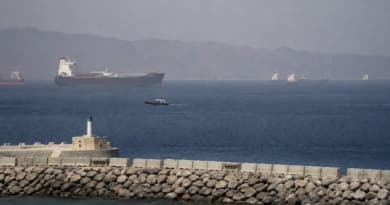
The most acute concern for regional officials is the potential spillover into commerce and energy security. Iran has historically used its geographic position as leverage, with the Strait of Hormuz serving as a critical chokepoint for global oil shipments. Even without direct military action, Iranian threats can raise shipping insurance costs and unsettle energy markets.
- Cross-border trade with Iraq, Turkey, Pakistan, and Afghanistan remains a lifeline for Iranian goods under sanctions.
- Informal money exchanges, barter arrangements, and small-vessel shipping have grown as sanctions have deepened, making enforcement harder for the U.S. and its partners.
- Gulf energy platforms, desalination plants, and ports are highly exposed to any escalation in Iranian threats or irregular military activity.
Neighboring states must balance U.S. security guarantees against the risk that Iran could disrupt overland trade, encourage proxy attacks, or use cyber operations to retaliate for economic cooperation with Washington.
A broader standoff
The warning is the latest rhetorical salvo in a long-running U.S.-Iran standoff that has alternated between indirect talks, military confrontations, and escalating sanctions. Iranian officials have consistently said they will not negotiate under what they call maximum pressure, while Western governments insist the pressure is necessary to achieve a durable agreement.
For regional states, the message is clear: Iran expects neighbors to resist U.S. demands, and it is prepared to make that expectation felt. Whether the threat remains rhetorical or translates into concrete action will depend on how aggressively Washington pursues the new campaign and how much cooperation it requests from countries on Iran’s borders.
Diplomats and security officials in the region are likely to watch closely for any follow-up: changes in border trade policy, new security incidents, or a shift in Iran’s relations with Gulf states that have only recently restored diplomatic ties. For now, the warning itself is a reminder that economic pressure campaigns rarely remain confined to ledger books and sanctions lists.