AWS Showcases Agentic AI to Slash Aircraft In-Flight Connectivity Troubleshooting Time
AWS Showcases Agentic AI to Slash Aircraft In-Flight Connectivity Troubleshooting Time
Amazon Web Services (AWS) has published a forward-looking technical solution that harnesses agentic artificial intelligence to accelerate diagnostics for aircraft In-Flight Entertainment and Connectivity (IFEC) systems. The concept, detailed in a post on the AWS Machine Learning Blog, envisions a future where AI agents guide maintenance technicians through complex multi-step troubleshooting, potentially cutting hours of downtime and improving aircraft availability.
The blog post, published on 21 August 2026 by a team of eight AWS specialists—Satyen Yadav, Hardik Shah, Matt Backel, Nimish Radia, Rajesh Balakrishnan, Ram Chintala, Shubham Dhoka, and Yifu Hu—tackles a persistent challenge in commercial aviation: diagnosing intermittent or obscure faults in seatback screens, cabin Wi-Fi, and the intricate network of servers and antennas that make up modern IFEC systems.
Understanding IFEC Diagnostics Challenges
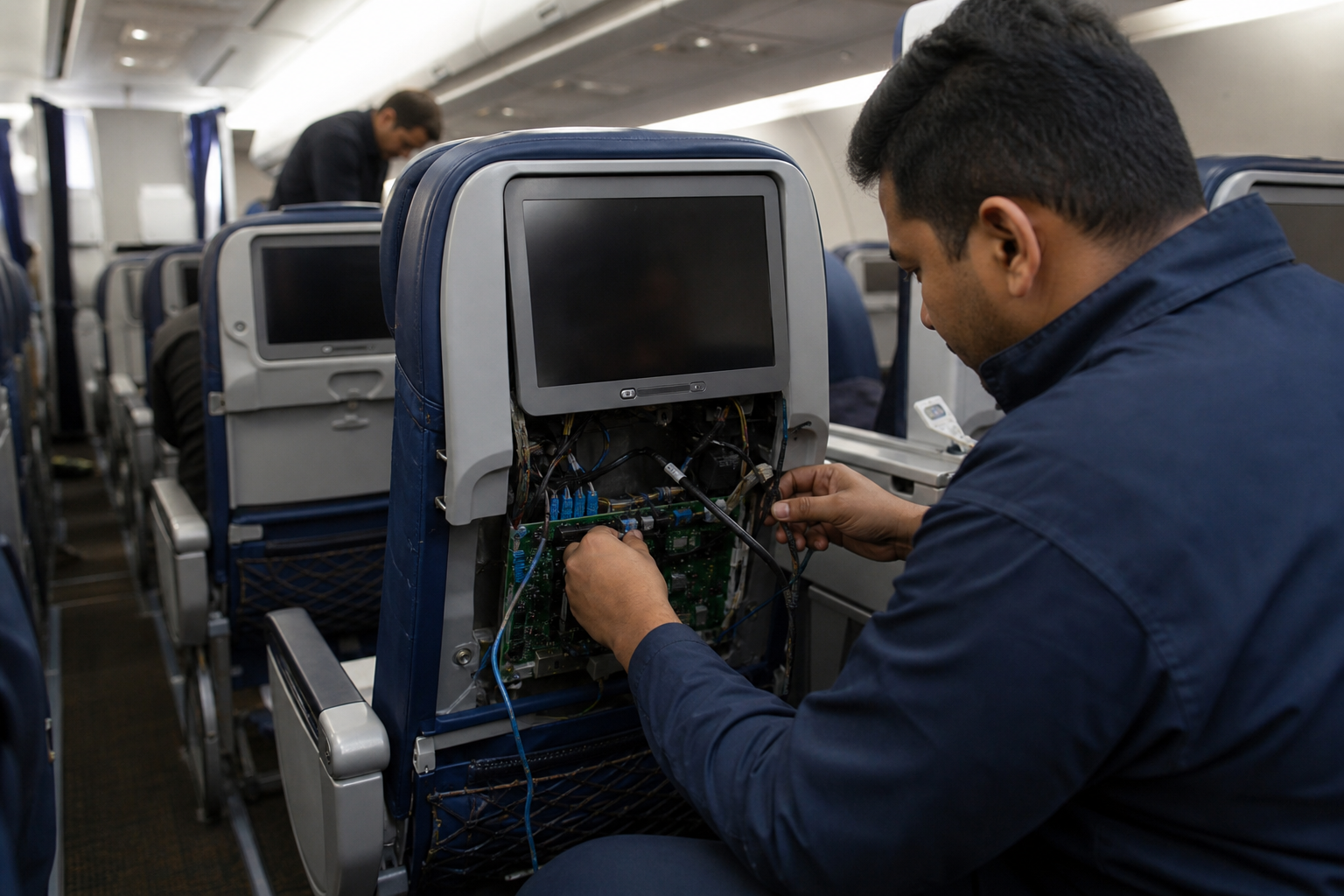
IFEC problems are notoriously difficult to troubleshoot because they often involve a mix of hardware, software, and connectivity layers. A malfunctioning seat screen might trace its root cause to a faulty server, a misconfigured router, or even an uplink issue with a satellite provider. Today, maintenance crews rely on static manuals, experience, and sometimes trial-and-error, which can prolong aircraft ground time.
The aviation industry’s strict safety and regulatory framework—overseen by bodies like the Federal Aviation Administration and industry standards from the International Air Transport Association—adds rigor but also complexity to every maintenance action. Any tool that speeds accurate diagnostics while maintaining compliance is of high value to airlines, MRO (Maintenance, Repair, and Overhaul) providers, and IFEC vendors.
Agentic AI: A Multi-Step Troubleshooting Assistant
Unlike a simple chatbot that answers one-off questions, an agentic AI system can autonomously reason through a diagnostic workflow. It can ask clarifying questions, consult maintenance databases, interpret error logs, and even suggest specific tests—all while adapting its approach based on the technician’s findings. AWS’s blog post frames these AI agents as virtual co-pilots for the maintenance engineer, capable of reducing mean time to repair by systematically isolating the root cause.
The proposed system would draw on AWS cloud services to host and orchestrate these AI agents. It could integrate with aircraft health monitoring data, historical fault records, and technical documentation, building a comprehensive knowledge base that an agent can query in real time. The result is a decision-support system that helps a technician, whether on the tarmac or in a remote operations center, reach a fix faster.
AWS’s Cloud and AI Stack for Aviation Maintenance
The blog positions AWS’s suite of AI and data services—including machine learning platforms, serverless computing, and generative AI capabilities—as the enabling infrastructure for such agentic workflows. While the post does not name a specific airline, aircraft manufacturer, or IFEC vendor as a deployment partner, it underscores the potential for the technology to transform maintenance operations across the sector.
In a typical scenario described, an agent could compare live aircraft data with fleet-wide baselines, alerting engineers to anomalies in connectivity performance and tracing those anomalies to a specific line-replaceable unit. It might then generate a step-by-step procedure tailored to the exact combination of aircraft type, software version, and fault code—yanking useful bits from thousands of pages of manuals in seconds.
Production Reality and Industry Implications
It remains unclear how much of the solution is fully operational versus a conceptual demonstration. The AWS post is marked in the company’s “Advanced (300)” technical content tier, suggesting a relatively deep dive for a technically adept audience, but not necessarily a product launch announcement. The absence of a named customer or deployment timeline indicates that, for now, this is an architectural blueprint and a proof-of-value argument for cloud-based agentic diagnostics.
Nevertheless, the concept arrives at a time when airlines are looking to squeeze more operational efficiency from their fleets. With aircraft utilization still under pressure and passenger expectations for seamless connectivity growing, any tool that can trim turnaround times and reduce no-fault-found incidents is likely to attract interest. Agentic AI on AWS offers a glimpse of a maintenance future where every technician has an expert-level assistant in the palm of their hand.