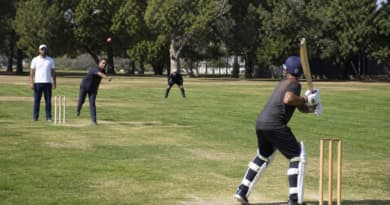
From Lord’s to the Diamond: Liam Plunkett’s Baseball Odyssey After World Cup Glory
The England Hero Who Traded Crease for Mound
Liam Plunkett, the fast bowler whose middle-overs breakthroughs helped propel England to a nerve-shredding World Cup final victory in 2019, has emerged as the protagonist of an extraordinary sporting experiment. At an age when most international cricketers settle into coaching or commentary, Plunkett has chosen to chase the improbable: a career in professional baseball.
A revealing new profile of the 38-year-old, whose England career spanned 13 years and yielded more than 120 caps across all formats, details how he walked away from the familiar rhythms of county cricket and into the alien environment of a baseball diamond. The journey is no gimmick; Plunkett has immersed himself in the sport, grappling with a delivery motion that is mechanically distinct from the catapult-like bowling action that once baffled batsmen at Lord’s.
Plunkett’s cricketing legacy is secure. A key cog in Eoin Morgan’s revolutionary white-ball unit, he took 3 for 42 in the 2019 final against New Zealand, a match that ended in a tied super over and an unforgettable boundary-countback victory. His ability to hit the pitch hard and extract awkward bounce earned him a reputation as a World Cup specialist, culminating in that sun-drenched July afternoon at Lord’s. (For a complete breakdown of his international numbers, see Liam Plunkett’s ESPNcricinfo profile.)
Tackling the Mechanics Chasm
The transition from cricket to baseball is far from a straightforward translation of talent. While both sports involve throwing a hard ball at high velocity, the biomechanics diverge in ways that can confound even world-class athletes. A cricket fast bowler uses a straight arm, a long run-up, and a release that relies on wrist snap and seam position; a baseball pitcher operates from a stationary mound, delivers with a bent elbow, and must master a repertoire of spin and velocity variations within a zone that demands pinpoint accuracy.
According to the recently published feature, Plunkett has been forced to rebuild his throwing mechanics from the ground up. Training sessions have focused on developing a consistent pitching delivery, building arm strength in a different plane, and learning to read batters rather than batsmen. The profile underscores how even the concept of fielding—positioned reactively in baseball versus proactively in cricket’s slip cordon—tested Plunkett’s athletic instincts.
Perhaps the steepest learning curve has been the professional baseball ecosystem itself. Unlike cricket, where an international career is often the pinnacle, baseball’s player-development pipeline in the United States is complex, with multiple minor-league tiers and a culture that demands years of apprenticeship before a shot at the major leagues. For a player entering the sport in his late thirties, the odds are microscopically small, yet Plunkett’s determination has attracted attention from coaches and scouts curious about the crossover potential.
Beyond the Boundary: Athlete Reinvention in the Modern Era
Plunkett’s baseball sojourn taps into a broader narrative about elite athletes seeking second acts outside their primary disciplines. From Michael Jordan’s famous switch to baseball in the 1990s to Jarryd Hayne’s attempted leap from rugby league to the NFL, the fascination lies in watching supreme physical gifts collide with new rulebooks. In a cricketing context, Plunkett’s path is almost unprecedented: no England men’s international of his stature has publicly pursued baseball at a professional level after a full cricket career.
The profile suggests that Plunkett’s motivation goes beyond curiosity. It speaks to a deep-seated drive to compete, to challenge the body in fresh ways, and perhaps to redefine what a post-cricket life can look like. In an era where athletes are increasingly viewed as multi-sport brands, Plunkett’s experiment could open doors for other cricketers to explore opportunities in the United States, where cricket’s own footprint is rapidly growing through Major League Cricket.
For now, the former England quick is not making any grand claims about reaching the top of baseball. Instead, he appears to be relishing the freedom of being a beginner again—a stark contrast to the high-stakes pressure of defending a World Cup title. Whether he ever throws a competitive pitch in a minor-league ballpark or simply returns home with a richer understanding of another sport, Plunkett’s cross-sport venture is a testament to the restless curiosity that separates great athletes from the merely good.
A Story That Keeps Evolving
As the cricket world digests the details of this unlikely journey, Plunkett’s baseball chapter is still being written. The profile makes clear that his attempt is far from over; he continues to train, to adapt, and to confront the daily humbling that comes with mastering a new craft. For fans of the 2019 World Cup hero, the image of a soaked Plunkett lifting the trophy may soon share space with a mental picture of the same bowler standing atop ten inches of clay, windup coiled, ready to fire a fastball into a catcher’s mitt.
In the meantime, the story offers a rich case study for coaches, sports scientists, and anyone fascinated by the limits of human adaptability. Liam Plunkett’s name may have been etched into cricket history, but he is currently proving that history is no reason to stop chasing the next pitch.