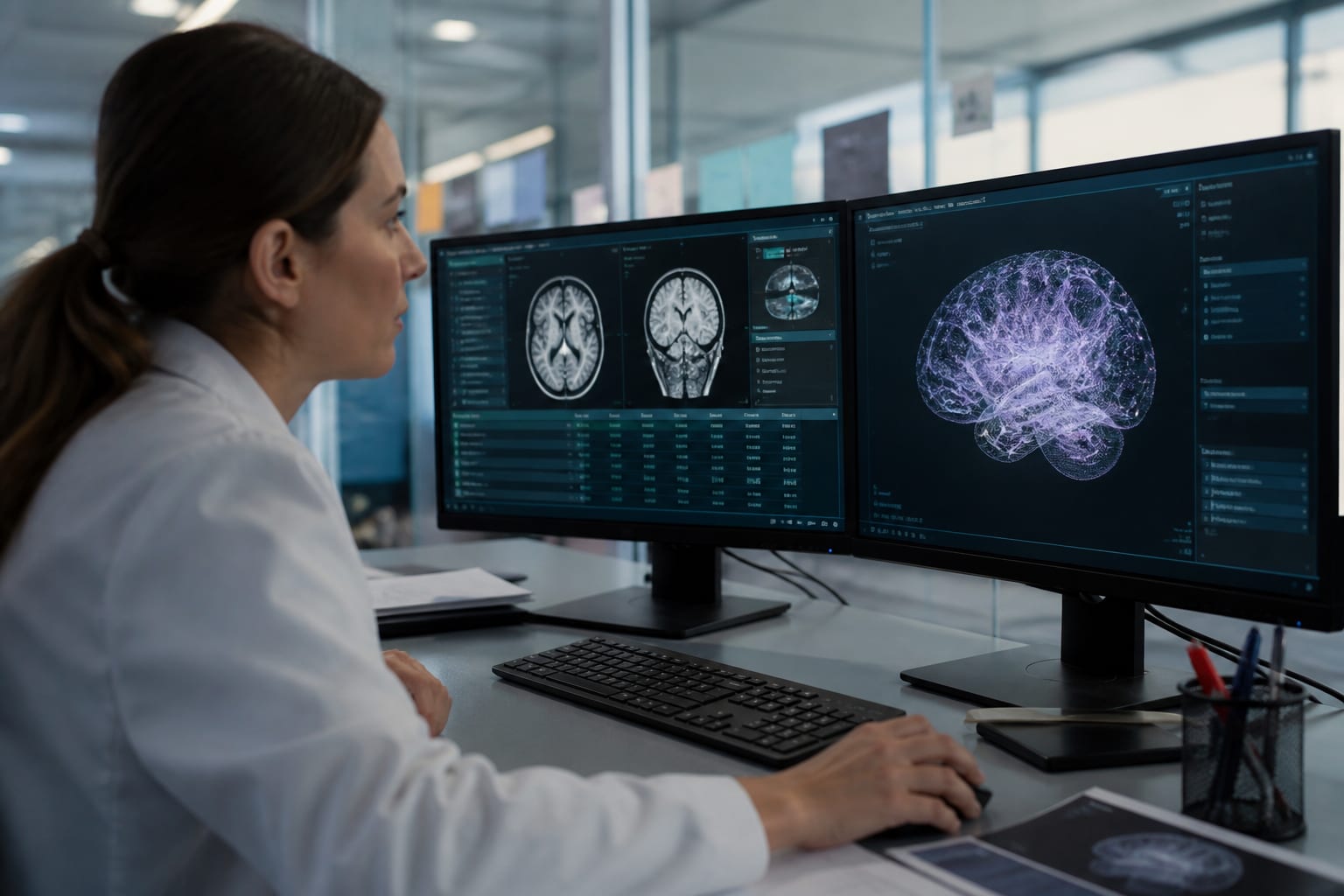
How AI Is Reshaping Psychiatric Training: Promise and Perils for Mental Health Education
Artificial Intelligence Is Entering the Psychiatry Classroom
Artificial intelligence is no longer a distant concept in mental health care — it is already influencing how future psychiatrists learn, diagnose, and make clinical decisions. A new wave of machine learning tools is transforming medical education, and psychiatry is part of that shift. From simulated patient interactions to pattern recognition in vast clinical datasets, AI is poised to augment psychiatric training in ways that were impossible just a decade ago. But alongside the excitement lie pressing concerns about ethics, bias, and the erosion of core clinical skills.
These tensions are captured in a recent analysis published in Cureus, which examines how AI is being integrated into psychiatric education and the careful balancing act required to harness its potential while protecting the human essence of mental health care.
Where Machine Learning Meets Mental Health Training
Traditionally, psychiatric training relies heavily on supervised clinical encounters, didactic teaching, and the slow accumulation of diagnostic intuition. AI tools are beginning to supplement these methods by offering:
- Learning support: Natural language processing can analyze trainee notes or interview transcripts, providing real-time feedback on clinical reasoning and communication style.
- Case simulation: Virtual patients powered by conversational AI allow trainees to practice rare or high-risk scenarios repeatedly without real-world consequences.
- Pattern recognition: Algorithms trained on large mental health datasets can highlight subtle symptom clusters or risk factors that might elude a novice clinician, helping trainees see beyond textbook presentations.
- Exposure to diverse data: AI can quickly surface de-identified case examples across different demographics and cultural contexts, broadening a trainee’s experience beyond the limits of their local clinical rotation.
These capabilities, proponents argue, could lead to earlier identification of conditions like depression or psychosis, more personalized learning pathways for residents, and better decision support during the formative years of a psychiatrist’s career.
Ethical Landmines and the Danger of Deskilling
Yet the very features that make AI attractive also raise red flags. Bias encoded in training data can produce skewed recommendations that disproportionately harm marginalized groups — a risk that is especially acute in psychiatry, where diagnostic criteria have a complex cultural history. Privacy is another flashpoint: mental health data is among the most sensitive, and trainees interacting with AI systems must learn to safeguard it.
“Explainability” is a further hurdle. Many advanced AI models operate as black boxes, making it difficult for supervisors to understand why a tool flagged a particular patient as high-risk. When a trainee relies on such an output, clinical safety and educational value are both called into question.
If a resident starts trusting the algorithm more than their own clinical interview, the whole foundation of psychiatric training — building therapeutic rapport and exercising clinical judgment — begins to erode.
Overreliance on AI tools risks deskilling future psychiatrists in the very competencies that define the profession: empathetic listening, the nuanced psychiatric interview, and the ability to tolerate diagnostic uncertainty without reaching for a digital crutch.
Redesigning Curricula for the AI Era
Medical educators and residency program directors now face a defining challenge: integrating AI into psychiatric training without sidelining the human-centered skills that remain irreplaceable. The American Psychiatric Association and other professional bodies are beginning to outline core competencies in digital and AI literacy for mental health clinicians.
Key questions that training programs must address include:
- How should AI tools be introduced so that they enhance, rather than replace, supervised clinical thinking?
- What ethical and legal frameworks should guide the use of AI in trainee-patient interactions?
- How can programs ensure that all residents, not just those with a technical background, develop a critical understanding of algorithmic bias and data privacy?
- In what ways must assessment methods evolve to measure a trainee’s ability to use AI judiciously — and to recognize when not to use it?
The World Health Organization has emphasized that digital mental health interventions must be evidence-based and human-rights-compliant — a principle that applies equally to the educational tools used to train the next generation of providers (WHO mental health guidance).
Preparing for a Hybrid Future
The conversation is shifting from whether AI belongs in psychiatric training to how it can be implemented responsibly. Some academic medical centers are already piloting AI-assisted clinical documentation and decision-support dashboards in residency clinics, while others are incorporating AI ethics modules into grand rounds and journal clubs.
Experts caution that technology should not be adopted simply because it exists. Any AI tool introduced into the training environment must be validated for safety, continuously monitored for bias, and accompanied by robust faculty development so that supervisors can guide its use effectively.
Ultimately, the goal is not to produce psychiatrists who are passive consumers of algorithmic outputs, but clinicians who are equipped to evaluate AI critically, communicate its limitations to patients, and advocate for equitable, transparent systems. The psychiatrist of the future will need both a stethoscope and a solid understanding of what happens inside the black box.
As AI reshapes the landscape of mental health education, the enduring mission of psychiatric training — to foster deep human connection, ethical reasoning, and adaptive clinical expertise — must remain its true north.